


Page 111 - Designing Sociable Robots
P. 111
breazeal-79017  book  March 18, 2002  14:54


                       92                                                               Chapter 7


                                             Soothing         Soothing
                                               vs
                                         Low-Intensity Neutral  Neutral
                          Soothing &
                         Low-Intensity
                                                             Approval
                           Neutral                              vs      Approval
                             vs          Approval & Attention  Attention  Attention
                        Everything Else        vs
                                            Prohibition
                                               vs             Prohibition
                                         High-Intensity Neutral
                                                              Neutral

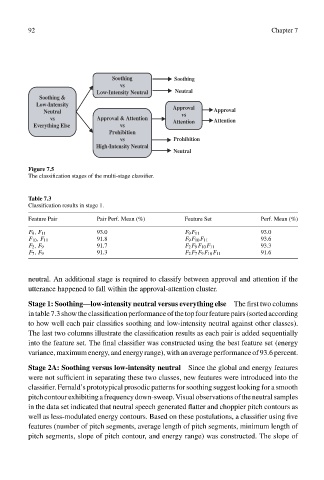
                       Figure 7.5
                       The classification stages of the multi-stage classifier.


                       Table 7.3
                       Classification results in stage 1.
                       Feature Pair      Pair Perf. Mean (%)     Feature Set         Perf. Mean (%)
                       F 9 , F 11        93.0                    F 9 F 11            93.0
                       F 10 , F 11       91.8                    F 9 F 10 F 11       93.6
                       F 2 , F 9         91.7                    F 2 F 9 F 10 F 11   93.3
                       F 7 , F 9         91.3                    F 2 F 7 F 9 F 10 F 11  91.6


                       neutral. An additional stage is required to classify between approval and attention if the
                       utterance happened to fall within the approval-attention cluster.

                       Stage 1: Soothing—low-intensity neutral versus everything else  The first two columns
                       intable7.3showtheclassificationperformanceofthetopfourfeaturepairs(sortedaccording
                       to how well each pair classifies soothing and low-intensity neutral against other classes).
                       The last two columns illustrate the classification results as each pair is added sequentially
                       into the feature set. The final classifier was constructed using the best feature set (energy
                       variance, maximum energy, and energy range), with an average performance of 93.6 percent.

                       Stage 2A: Soothing versus low-intensity neutral  Since the global and energy features
                       were not sufficient in separating these two classes, new features were introduced into the
                       classifier. Fernald’s prototypical prosodic patterns for soothing suggest looking for a smooth
                       pitchcontourexhibitingafrequencydown-sweep.Visualobservationsoftheneutralsamples
                       in the data set indicated that neutral speech generated flatter and choppier pitch contours as
                       well as less-modulated energy contours. Based on these postulations, a classifier using five
                       features (number of pitch segments, average length of pitch segments, minimum length of
                       pitch segments, slope of pitch contour, and energy range) was constructed. The slope of

