


Page 115 - Designing Sociable Robots
P. 115
breazeal-79017  book  March 18, 2002  14:54


                       96                                                               Chapter 7


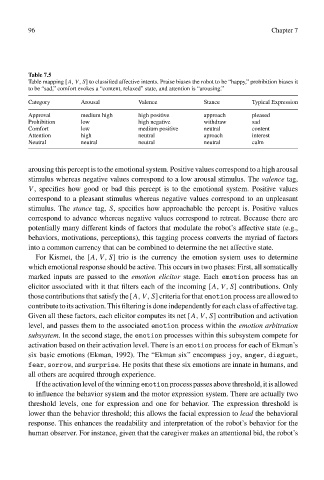
                       Table 7.5
                       Table mapping [A, V, S] to classified affective intents. Praise biases the robot to be “happy,” prohibition biases it
                       to be “sad,” comfort evokes a “content, relaxed” state, and attention is “arousing.”

                       Category      Arousal        Valence           Stance      Typical Expression
                       Approval      medium high    high positive     approach    pleased
                       Prohibition   low            high negative     withdraw    sad
                       Comfort       low            medium positive   neutral     content
                       Attention     high           neutral           aproach     interest
                       Neutral       neutral        neutral           neutral     calm


                       arousing this percept is to the emotional system. Positive values correspond to a high arousal
                       stimulus whereas negative values correspond to a low arousal stimulus. The valence tag,
                       V , specifies how good or bad this percept is to the emotional system. Positive values
                       correspond to a pleasant stimulus whereas negative values correspond to an unpleasant
                       stimulus. The stance tag, S, specifies how approachable the percept is. Positive values
                       correspond to advance whereas negative values correspond to retreat. Because there are
                       potentially many different kinds of factors that modulate the robot’s affective state (e.g.,
                       behaviors, motivations, perceptions), this tagging process converts the myriad of factors
                       into a common currency that can be combined to determine the net affective state.
                         For Kismet, the [A, V, S] trio is the currency the emotion system uses to determine
                       which emotional response should be active. This occurs in two phases: First, all somatically
                       marked inputs are passed to the emotion elicitor stage. Each emotion process has an
                       elicitor associated with it that filters each of the incoming [A, V, S] contributions. Only
                       those contributions that satisfy the [A, V, S] criteria for that emotion process are allowed to
                       contribute to its activation. This filtering is done independently for each class of affective tag.
                       Given all these factors, each elicitor computes its net [A, V, S] contribution and activation
                       level, and passes them to the associated emotion process within the emotion arbitration
                       subsystem. In the second stage, the emotion processes within this subsystem compete for
                       activation based on their activation level. There is an emotion process for each of Ekman’s
                       six basic emotions (Ekman, 1992). The “Ekman six” encompass joy, anger, disgust,
                       fear, sorrow, and surprise. He posits that these six emotions are innate in humans, and
                       all others are acquired through experience.
                         Iftheactivationlevelofthewinningemotionprocesspassesabovethreshold,itisallowed
                       to influence the behavior system and the motor expression system. There are actually two
                       threshold levels, one for expression and one for behavior. The expression threshold is
                       lower than the behavior threshold; this allows the facial expression to lead the behavioral
                       response. This enhances the readability and interpretation of the robot’s behavior for the
                       human observer. For instance, given that the caregiver makes an attentional bid, the robot’s

