


Page 110 - Designing Sociable Robots
P. 110
breazeal-79017  book  March 18, 2002  14:54


                       The Auditory System                                                   91


                        350
                                                                              approval
                                                                              attention
                                                                              soothing
                                                                              neutral
                        300
                                                                              prohibition
                        250


                        Energy Variance  200


                        150


                        100


                         50


                          0
                          100   150    200   250    300   350    400   450    500   550
                                                     Pitch Mean
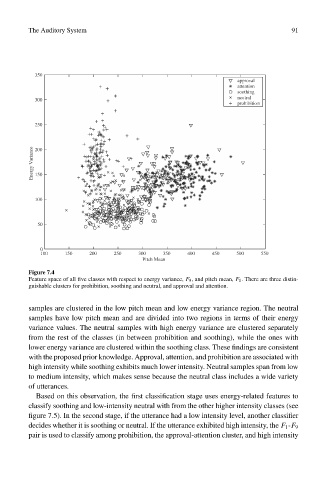
                       Figure 7.4
                       Feature space of all five classes with respect to energy variance, F 9 , and pitch mean, F 1 . There are three distin-
                       guishable clusters for prohibition, soothing and neutral, and approval and attention.


                       samples are clustered in the low pitch mean and low energy variance region. The neutral
                       samples have low pitch mean and are divided into two regions in terms of their energy
                       variance values. The neutral samples with high energy variance are clustered separately
                       from the rest of the classes (in between prohibition and soothing), while the ones with
                       lower energy variance are clustered within the soothing class. These findings are consistent
                       with the proposed prior knowledge. Approval, attention, and prohibition are associated with
                       high intensity while soothing exhibits much lower intensity. Neutral samples span from low
                       to medium intensity, which makes sense because the neutral class includes a wide variety
                       of utterances.
                         Based on this observation, the first classification stage uses energy-related features to
                       classify soothing and low-intensity neutral with from the other higher intensity classes (see
                       figure 7.5). In the second stage, if the utterance had a low intensity level, another classifier

                       decides whether it is soothing or neutral. If the utterance exhibited high intensity, the F 1 -F 9
                       pair is used to classify among prohibition, the approval-attention cluster, and high intensity

