


Page 207 - Designing Sociable Robots
P. 207
breazeal-79017  book  March 18, 2002  14:16


                       188                                                             Chapter 11


                       convey anger, fear, disgust, gladness, sadness, and surprise in synthetic speech. Emotions
                       have a global impact on speech since they modulate the respiratory system, larynx, vocal
                       tract, muscular system, heart rate, and blood pressure. The pitch-related parameters affect
                       the pitch contour of the speech signal, which is the primary contributor for affective infor-
                       mation. The pitch-related parameters include accent shape, average pitch, pitch contour
                       slope, final lowering, pitch range, and pitch reference line. The timing-related parameters
                       modify the prosody of the vocalization, often being reflected in speech rate and stress
                       placement. The timing-related parameters include speech rate, pauses, exaggeration, and
                       stress frequency. The voice-quality parameters include loudness, brilliance, breathiness,
                       laryngealization, pitch discontinuity, and pause discontinuity. The articulation parameter
                       modifies the precision of what is uttered, either being more enunciated or slurred. I describe
                       these parameters in detail in the next section.
                         For Kismet, only some of these parameters are needed since several are inherently tied
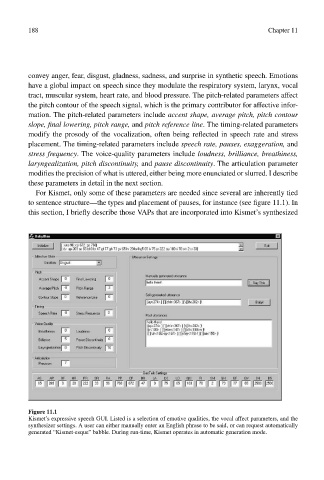
                       to sentence structure—the types and placement of pauses, for instance (see figure 11.1). In
                       this section, I briefly describe those VAPs that are incorporated into Kismet’s synthesized


                       Figure 11.1
                       Kismet’s expressive speech GUI. Listed is a selection of emotive qualities, the vocal affect parameters, and the
                       synthesizer settings. A user can either manually enter an English phrase to be said, or can request automatically
                       generated “Kismet-esque” babble. During run-time, Kismet operates in automatic generation mode.

