


Page 211 - Designing Sociable Robots
P. 211
breazeal-79017  book  March 18, 2002  14:16


                       192                                                             Chapter 11


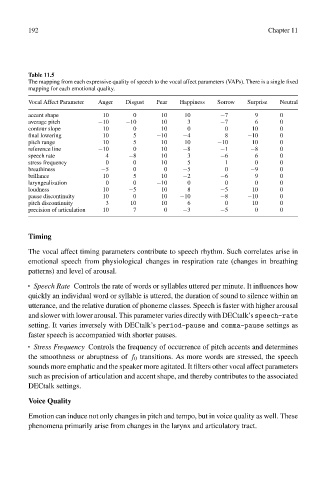
                       Table 11.5
                       The mapping from each expressive quality of speech to the vocal affect parameters (VAPs). There is a single fixed
                       mapping for each emotional quality.

                       Vocal Affect Parameter  Anger  Disgust  Fear  Happiness  Sorrow  Surprise  Neutral
                       accent shape        10      0      10    10        −7       9      0
                       average pitch      −10    −10      10     3        −7       6      0
                       contour slope       10      0      10     0         0      10      0
                       final lowering       10      5     −10    −4         8     −10      0
                       pitch range         10      5      10    10       −10      10      0
                       reference line     −10      0      10    −8        −1      −8      0
                       speech rate          4     −8      10     3        −6       6      0
                       stress frequency     0      0      10     5         1       0      0
                       breathiness        −5       0       0    −5         0      −9      0
                       brillance           10      5      10    −2        −6       9      0
                       laryngealization     0      0     −10     0         0       0      0
                       loudness            10     −5      10     8        −5      10      0
                       pause discontinuity  10     0      10   −10        −8     −10      0
                       pitch discontinuity  3     10      10     6         0      10      0
                       precision of articulation  10  7    0    −3        −5       0      0


                       Timing
                       The vocal affect timing parameters contribute to speech rhythm. Such correlates arise in
                       emotional speech from physiological changes in respiration rate (changes in breathing
                       patterns) and level of arousal.
                       •  Speech Rate Controls the rate of words or syllables uttered per minute. It influences how
                       quickly an individual word or syllable is uttered, the duration of sound to silence within an
                       utterance, and the relative duration of phoneme classes. Speech is faster with higher arousal
                       and slower with lower arousal. This parameter varies directly with DECtalk’s speech-rate
                       setting. It varies inversely with DECtalk’s period-pause and comma-pause settings as
                       faster speech is accompanied with shorter pauses.
                       •  Stress Frequency Controls the frequency of occurrence of pitch accents and determines
                       the smoothness or abruptness of f 0 transitions. As more words are stressed, the speech
                       sounds more emphatic and the speaker more agitated. It filters other vocal affect parameters
                       such as precision of articulation and accent shape, and thereby contributes to the associated
                       DECtalk settings.

                       Voice Quality

                       Emotion can induce not only changes in pitch and tempo, but in voice quality as well. These
                       phenomena primarily arise from changes in the larynx and articulatory tract.

