


Page 39 - Designing Sociable Robots
P. 39
breazeal-79017  book  March 18, 2002  13:56


                       20                                                               Chapter 2


                       Embodied Conversation Agents

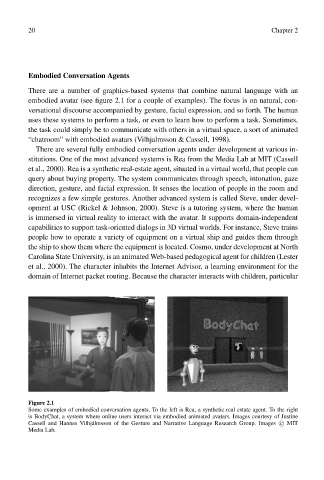
                       There are a number of graphics-based systems that combine natural language with an
                       embodied avatar (see figure 2.1 for a couple of examples). The focus is on natural, con-
                       versational discourse accompanied by gesture, facial expression, and so forth. The human
                       uses these systems to perform a task, or even to learn how to perform a task. Sometimes,
                       the task could simply be to communicate with others in a virtual space, a sort of animated
                       “chatroom” with embodied avatars (Vilhjalmsson & Cassell, 1998).
                         There are several fully embodied conversation agents under development at various in-
                       stitutions. One of the most advanced systems is Rea from the Media Lab at MIT (Cassell
                       et al., 2000). Rea is a synthetic real-estate agent, situated in a virtual world, that people can
                       query about buying property. The system communicates through speech, intonation, gaze
                       direction, gesture, and facial expression. It senses the location of people in the room and
                       recognizes a few simple gestures. Another advanced system is called Steve, under devel-
                       opment at USC (Rickel & Johnson, 2000). Steve is a tutoring system, where the human
                       is immersed in virtual reality to interact with the avatar. It supports domain-independent
                       capabilities to support task-oriented dialogs in 3D virtual worlds. For instance, Steve trains
                       people how to operate a variety of equipment on a virtual ship and guides them through
                       the ship to show them where the equipment is located. Cosmo, under development at North
                       Carolina State University, is an animated Web-based pedagogical agent for children (Lester
                       et al., 2000). The character inhabits the Internet Advisor, a learning environment for the
                       domain of Internet packet routing. Because the character interacts with children, particular


                       Figure 2.1
                       Some examples of embodied conversation agents. To the left is Rea, a synthetic real estate agent. To the right
                       is BodyChat, a system where online users interact via embodied animated avatars. Images courtesy of Justine
                       Cassell and Hannes Vilhj´almsson of the Gesture and Narrative Language Research Group. Images c   MIT
                       Media Lab.

