


Page 43 - Designing Sociable Robots
P. 43
breazeal-79017  book  March 18, 2002  13:56


                       24                                                               Chapter 2


                       Personal Robots

                       There are a number of robotic projects that focus on operating within human environ-
                       ments. Typically these robots are not humanoid in form, but are designed to support natural
                       communication channels such as gesture or speech.
                         There are a few robots that are being designed for domestic use. For systems such as
                       these, safety and minimizing impact on human living spaces are important issues as well as
                       performance and ease of use. Many applications of this kind focus on providing assistance
                       to the elderly or to the disabled. The MOVAID system (Dario & Susani, 1996) and a similar
                       project at Vanderbilt University (Kawamura et al., 1996). In a somewhat related effort,
                       Dautenhahn (1999) has employed autonomous robots to assist in social therapy of fairly
                       high-functioning autistic children.
                         In the entertainment market, there are a growing number of synthetic pets (both robotic
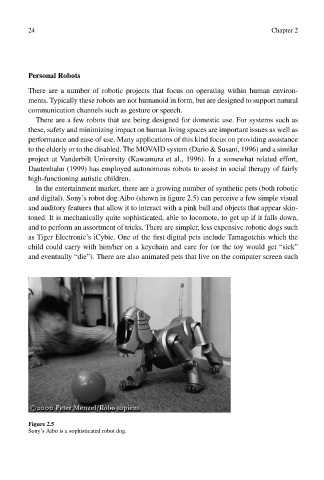
                       and digital). Sony’s robot dog Aibo (shown in figure 2.5) can perceive a few simple visual
                       and auditory features that allow it to interact with a pink ball and objects that appear skin-
                       toned. It is mechanically quite sophisticated, able to locomote, to get up if it falls down,
                       and to perform an assortment of tricks. There are simpler, less expensive robotic dogs such
                       as Tiger Electronic’s iCybie. One of the first digital pets include Tamagotchis which the
                       child could carry with him/her on a keychain and care for (or the toy would get “sick”
                       and eventually “die”). There are also animated pets that live on the computer screen such


                       Figure 2.5
                       Sony’s Aibo is a sophisticated robot dog.

