


Page 42 - Designing Sociable Robots
P. 42
breazeal-79017  book  March 18, 2002  13:56


                       Robot in Society: A Question of Interface                             23


                       incorporate hair, teeth, silicone skin, and a large number of control points (Hara, 1998). Each
                       control point maps to a facial action unit of a human face. The facial action units characterize
                       how each facial muscle (or combination of facial muscles) adjust the skin and facial features
                       to produce human expressions and facial movements (Ekman & Friesen, 1982). Using a
                       camera mounted in the left eyeball, the robot can recognize and produce a predefined set
                       of emotive facial expressions (corresponding to anger, fear, disgust, happiness, sorrow, and
                       surprise). A number of simpler expressive faces have been developed at Waseda University,
                       one of which can adjust its amount of eye-opening and neck posture in response to light
                       intensity (Takanobu et al., 1999).
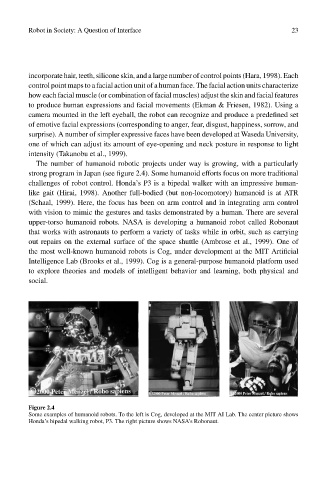
                         The number of humanoid robotic projects under way is growing, with a particularly
                       strong program in Japan (see figure 2.4). Some humanoid efforts focus on more traditional
                       challenges of robot control. Honda’s P3 is a bipedal walker with an impressive human-
                       like gait (Hirai, 1998). Another full-bodied (but non-locomotory) humanoid is at ATR
                       (Schaal, 1999). Here, the focus has been on arm control and in integrating arm control
                       with vision to mimic the gestures and tasks demonstrated by a human. There are several
                       upper-torso humanoid robots. NASA is developing a humanoid robot called Robonaut
                       that works with astronauts to perform a variety of tasks while in orbit, such as carrying
                       out repairs on the external surface of the space shuttle (Ambrose et al., 1999). One of
                       the most well-known humanoid robots is Cog, under development at the MIT Artificial
                       Intelligence Lab (Brooks et al., 1999). Cog is a general-purpose humanoid platform used
                       to explore theories and models of intelligent behavior and learning, both physical and
                       social.


                       Figure 2.4
                       Some examples of humanoid robots. To the left is Cog, developed at the MIT AI Lab. The center picture shows
                       Honda’s bipedal walking robot, P3. The right picture shows NASA’s Robonaut.

