


Page 40 - Designing Sociable Robots
P. 40
breazeal-79017  book  March 18, 2002  13:56


                       Robot in Society: A Question of Interface                             21


                       attention is paid to the issues of life-like behavior and engaging the students at an affec-
                       tive level.
                         There are a number of graphical systems where the avatar predominantly consists of a
                       face with minimal to no body. A good example is Gandalf, a precursor system of Rea. The
                       graphical component of the agent consisted of a face and a hand. It could answer a variety
                       of questions about the solar system but required the user to wear a substantial amount of
                       equipment in order to sense the user’s gestures and head orientation (Thorisson, 1998). In
                       Takeuchi and Nagao (1993), the use of an expressive graphical face to accompany dialogue
                       is explored. They found that the facial component was good for initiating new users to the
                       system, but its benefit was not as pronounced over time.
                       Interactive Characters

                       There are a variety of interactive characters under development for the entertainment do-
                       main. The emphasis for each system is compelling, life-like behavior and characters with
                       personality. Expressive, readable behavior is of extreme importance for the human to un-
                       derstand the interactive story line. Instead of passively viewing a scripted story, the user
                       creates the story interactively with the characters.
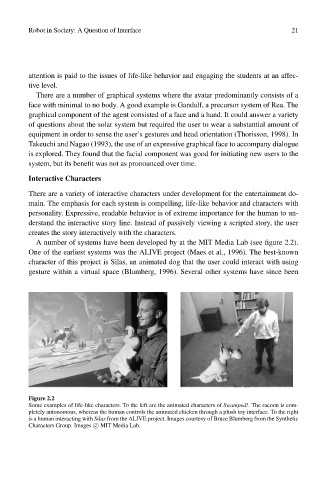
                         A number of systems have been developed by at the MIT Media Lab (see figure 2.2).
                       One of the earliest systems was the ALIVE project (Maes et al., 1996). The best-known
                       character of this project is Silas, an animated dog that the user could interact with using
                       gesture within a virtual space (Blumberg, 1996). Several other systems have since been


                       Figure 2.2
                       Some examples of life-like characters. To the left are the animated characters of Swamped!. The racoon is com-
                       pletely autonomous, whereas the human controls the animated chicken through a plush toy interface. To the right
                       is a human interacting with Silas from the ALIVE project. Images courtesy of Bruce Blumberg from the Synthetic
                       Characters Group. Images c   MIT Media Lab.

