


Page 207 - Determinants and Their Applications in Mathematical Physics
P. 207
192   5. Further Determinant Theory
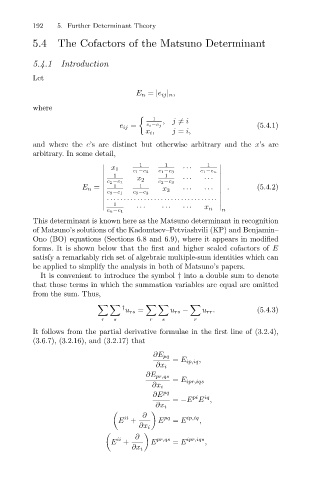
          5.4   The Cofactors of the Matsuno Determinant


          5.4.1  Introduction
          Let

                                     E n = |e ij | n ,
          where

                                         1  ,j  = i
                                e ij =  c i −c j                     (5.4.1)
                                       x i ,  j = i,
          and where the c’s are distinct but otherwise arbitrary and the x’s are
          arbitrary. In some detail,
                                      1     1          1
                              x 1                ···
                                    c 1 −c 2  c 1 −c 3
                               1            1
                                                      c 1 −c n
                                     x 2
                                                 ···   ···
                              c 2 −c 1     c 2 −c 3
                       E n =     1    1          ···          .      (5.4.2)
                              c 3 −c 1  c 3 −c 2  x 3  ···

                              .................................
                               1
                                     ···    ···  ···

                             c n −c 1                  x n  n
          This determinant is known here as the Matsuno determinant in recognition
          of Matsuno’s solutions of the Kadomtsev–Petviashvili (KP) and Benjamin–
          Ono (BO) equations (Sections 6.8 and 6.9), where it appears in modified
          forms. It is shown below that the first and higher scaled cofactors of E
          satisfy a remarkably rich set of algebraic multiple-sum identities which can
          be applied to simplify the analysis in both of Matsuno’s papers.
            It is convenient to introduce the symbol † into a double sum to denote
          that those terms in which the summation variables are equal are omitted
          from the sum. Thus,

                                  u rs =      u rs −  u rr .         (5.4.3)
                                 †
                            r  s        r   s       r
          It follows from the partial derivative formulae in the first line of (3.2.4),
          (3.6.7), (3.2.16), and (3.2.17) that
                                              = E ip,iq ,
                                         ∂E pq
                                          ∂x i
                                       ∂E pr,qs
                                         ∂x i
                                         ∂E  pq  = E ipr,iqs
                                              = −E E ,
                                                    pi
                                                       iq

 ∂x i
                                      ∂
                                E +        E  pq  = E ip,iq ,
                                  ii
                             	        ∂x i
                                     ∂

                              E +   ∂x i  E pr,qs  = E ipr,iqs ,
                                ii

