


Page 289 - Digital Analysis of Remotely Sensed Imagery
P. 289
Spectral Image Analysis     251


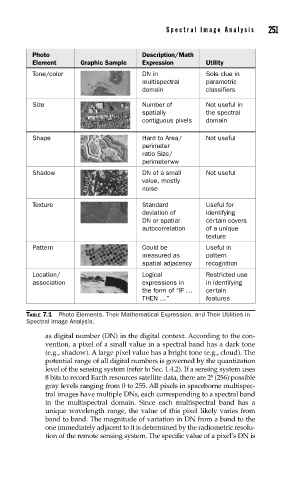
            Photo                         Description/Math
            Element      Graphic Sample   Expression       Utility
            Tone/color                    DN in            Sole clue in
                                          multispectral    parametric
                                          domain           classifiers
            Size                          Number of        Not useful in
                                          spatially        the spectral
                                          contiguous pixels  domain

            Shape                         Hard to Area/    Not useful
                                          perimeter
                                          ratio Size/
                                          perimeterww
            Shadow                        DN of a small    Not useful
                                          value, mostly
                                          noise

            Texture                       Standard         Useful for
                                          deviation of     identifying
                                          DN or spatial    certain covers
                                          autocorrelation  of a unique
                                                           texture
            Pattern                       Could be         Useful in
                                          measured as      pattern
                                          spatial adjacency  recognition
            Location/                     Logical          Restricted use
            association                   expressions in   in identifying
                                          the form of “IF …   certain
                                          THEN …”          features
          TABLE 7.1  Photo Elements, Their Mathematical Expression, and Their Utilities in
          Spectral Image Analysis.
               as digital number (DN) in the digital context. According to the con-
               vention, a pixel of a small value in a spectral band has a dark tone
               (e.g., shadow). A large pixel value has a bright tone (e.g., cloud). The
               potential range of all digital numbers is governed by the quantization
               level of the sensing system (refer to Sec. 1.4.2). If a sensing system uses
                                                             8
               8 bits to record Earth resources satellite data, there are 2  (256) possible
               gray levels ranging from 0 to 255. All pixels in spaceborne multispec-
               tral images have multiple DNs, each corresponding to a spectral band
               in the multispectral domain. Since each multispectral band has a
               unique wavelength range, the value of this pixel likely varies from
               band to band. The magnitude of variation in DN from a band to the
               one immediately adjacent to it is determined by the radiometric resolu-
               tion of the remote sensing system. The specific value of a pixel’s DN is

