


Page 293 - Digital Analysis of Remotely Sensed Imagery
P. 293
Spectral Image Analysis     255


                                      Informational class
                                        “vegetation”


                  Spectral subclasses  Spectral subclasses  Spectral subclasses
                arising from variation in  arising from variation in  arising from growing
                     illumination        species            condition


                Shadowed   Sunlit                        Healthy  Drought
                  slope    slope      Shrubs  Forest             stricken
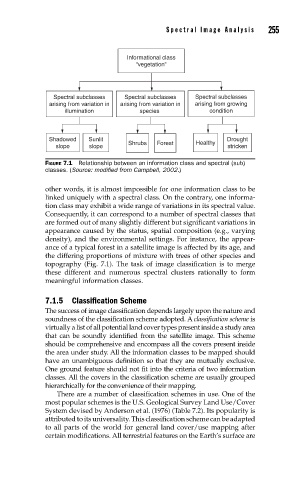
               FIGURE 7.1  Relationship between an information class and spectral (sub)
               classes. (Source: modifi ed from Campbell, 2002.)

               other words, it is almost impossible for one information class to be
               linked uniquely with a spectral class. On the contrary, one informa-
               tion class may exhibit a wide range of variations in its spectral value.
               Consequently, it can correspond to a number of spectral classes that
               are formed out of many slightly different but significant variations in
               appearance caused by the status, spatial composition (e.g., varying
               density), and the environmental settings. For instance, the appear-
               ance of a typical forest in a satellite image is affected by its age, and
               the differing proportions of mixture with trees of other species and
               topography (Fig. 7.1). The task of image classification is to merge
               these different and numerous spectral clusters rationally to form
               meaningful information classes.


               7.1.5 Classification Scheme
               The success of image classification depends largely upon the nature and
               soundness of the classification scheme adopted. A classification scheme is
               virtually a list of all potential land cover types present inside a study area
               that can be soundly identified from the satellite image. This scheme
               should be comprehensive and encompass all the covers present inside
               the area under study. All the information classes to be mapped should
               have an unambiguous definition so that they are mutually exclusive.
               One ground feature should not fit into the criteria of two information
               classes. All the covers in the classification scheme are usually grouped
               hierarchically for the convenience of their mapping.
                   There are a number of classification schemes in use. One of the
               most popular schemes is the U.S. Geological Survey Land Use/Cover
               System devised by Anderson et al. (1976) (Table 7.2). Its popularity is
               attributed to its universality. This classification scheme can be adapted
               to all parts of the world for general land cover/use mapping after
               certain modifications. All terrestrial features on the Earth’s surface are

