


Page 297 - Digital Analysis of Remotely Sensed Imagery
P. 297
Spectral Image Analysis     259

               of spectral similarity, euclidean spectral distance can serve as a mem-
               bership function. If a pixel has a shorter distance to the center of one
               cluster than to the center of another, then it is more likely to be a
               member of the former cluster because it shares a higher spectral sim-
               ilarity with all the pixels in that cluster.


               7.2.2 Mahalanobis Spectral Distance
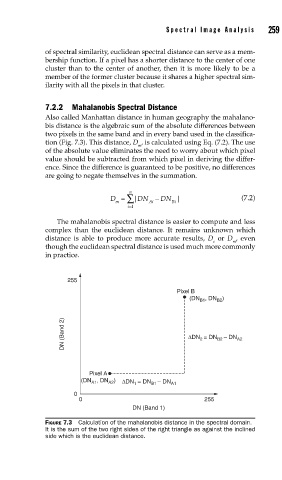
               Also called Manhattan distance in human geography the mahalano-
               bis distance is the algebraic sum of the absolute differences between
               two pixels in the same band and in every band used in the classifica-
               tion (Fig. 7.3). This distance, D , is calculated using Eq. (7.2). The use
                                         m
               of the absolute value eliminates the need to worry about which pixel
               value should be subtracted from which pixel in deriving the differ-
               ence. Since the difference is guaranteed to be positive, no differences
               are going to negate themselves in the summation.


                                   m ∑
                                 D =  n  | DN −  DN |                (7.2)
                                                  Bi
                                            Ai
                                      i=1
                   The mahalanobis spectral distance is easier to compute and less
               complex than the euclidean distance. It remains unknown which
               distance is able to produce more accurate results,  D  or  D , even
                                                             e     m
               though the euclidean spectral distance is used much more commonly
               in practice.


                      255
                                                   Pixel B
                                                       (DN , DN )
                                                          B1
                                                              B2
                    DN (Band 2)                        ΔDN = DN B2  – DN A2


                                                          2


                           Pixel A
                         (DN , DN A2 )  ΔDN = DN B1  – DN A1
                            A1
                                        1
                       0
                         0                                 255
                                       DN (Band 1)
               FIGURE 7.3  Calculation of the mahalanobis distance in the spectral domain.
               It is the sum of the two right sides of the right triangle as against the inclined
               side which is the euclidean distance.

