


Page 298 - Digital Analysis of Remotely Sensed Imagery
P. 298
260    Cha pte r  Se v e n

               7.2.3 Normalized Distance
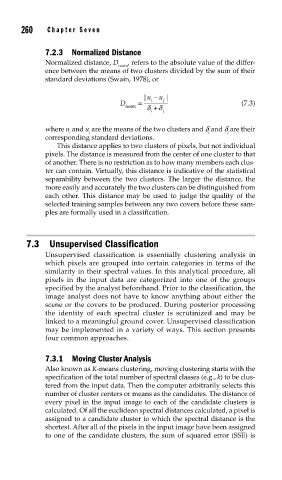
               Normalized distance, D  , refers to the absolute value of the differ-
                                   norm
               ence between the means of two clusters divided by the sum of their
               standard deviations (Swain, 1978), or

                                          | u −  u |
                                                j
                                            i
                                    D    =                           (7.3)
                                     norm  δ  +δ
                                            i   j
               where u and u are the means of the two clusters and d and d are their
                      i    j                                i    j
               corresponding standard deviations.
                   This distance applies to two clusters of pixels, but not individual
               pixels. The distance is measured from the center of one cluster to that
               of another. There is no restriction as to how many members each clus-
               ter can contain. Virtually, this distance is indicative of the statistical
               separability between the two clusters. The larger the distance, the
               more easily and accurately the two clusters can be distinguished from
               each other. This distance may be used to judge the quality of the
               selected training samples between any two covers before these sam-
               ples are formally used in a classification.


          7.3 Unsupervised Classification
               Unsupervised classification is essentially clustering analysis in
               which pixels are grouped into certain categories in terms of the
               similarity in their spectral values. In this analytical procedure, all
               pixels in the input data are categorized into one of the groups
               specified by the analyst beforehand. Prior to the classification, the
               image analyst does not have to know anything about either the
               scene or the covers to be produced. During posterior processing
               the identity of each spectral cluster is scrutinized and may be
               linked to a meaningful ground cover. Unsupervised classification
               may be implemented in a variety of ways. This section presents
               four common approaches.


               7.3.1 Moving Cluster Analysis
               Also known as K-means clustering, moving clustering starts with the
               specification of the total number of spectral classes (e.g., k) to be clus-
               tered from the input data. Then the computer arbitrarily selects this
               number of cluster centers or means as the candidates. The distance of
               every pixel in the input image to each of the candidate clusters is
               calculated. Of all the euclidean spectral distances calculated, a pixel is
               assigned to a candidate cluster to which the spectral distance is the
               shortest. After all of the pixels in the input image have been assigned
               to one of the candidate clusters, the sum of squared error (SSE) is

