


Page 130 - Distributed model predictive control for plant-wide systems
P. 130
104                           Distributed Model Predictive Control for Plant-Wide Systems


           by which the Pareto optimality is accomplished. In addition, some simulations are provided to
           illustrate the efficiency of the proposed methods.


           6.2   Noniterative Cooperative DMPC

           6.2.1   System Description
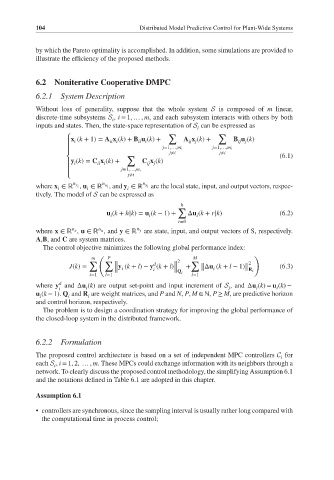
           Without loss of generality, suppose that the whole system S is composed of m linear,
           discrete-time subsystems S , i = 1, … , m, and each subsystem interacts with others by both
                                 i
           inputs and states. Then, the state-space representation of S can be expressed as
                                                          i
                                                 ∑              ∑
                    ⎧ x (k + 1) = A x (k)+ B u (k)+   A x (k)+      B u (k)
                      i          ii i    ii i          ij j           ij j
                    ⎪
                                                j=1,…,m;      j=1,…,m;
                    ⎪                             j≠i           j≠i
                                      ∑                                           (6.1)
                    ⎨
                     y (k)= C x (k)+
                                           ij j
                    ⎪ i      ii i         C x (k)
                    ⎪               j=1,…,m,
                    ⎩                 j≠i
           where x ∈ ℝ , u ∈ ℝ , and y ∈ ℝ n y i are the local state, input, and output vectors, respec-
                               n u i
                      n x i
                                      i
                          i
                  i
           tively. The model of S can be expressed as
                                                     h
                                                    ∑
                                u (k + h|k)= u (k − 1)+  Δu (k + r|k)             (6.2)
                                 i
                                                          i
                                            i
                                                    r=0
           where x ∈ ℝ , u ∈ ℝ , and y ∈ ℝ n y  are state, input, and output vectors of S, respectively.
                      n x
                             n u
           A,B, and C are system matrices.
             The control objective minimizes the following global performance index:
                              (                                           )
                           m    P                        M
                           ∑ ∑               d      2   ∑                2
                     J(k)=        ‖  i       i     ‖   +   ‖ Δu (k + l − 1) ‖     (6.3)
                                  ‖y (k + l) − y (k + l)‖
                                                               i
                                  ‖                ‖Q i    ‖            ‖R i
                           i=1  l=1                     l=1
                  d
           where y and Δu (k) are output set-point and input increment of S , and Δu (k) = u (k) −
                                                                           i
                                                                                 i
                          i
                                                                   j
                  i
           u (k − 1). Q and R are weight matrices, and P and N, P, M ∈ ℕ, P ≥ M, are predictive horizon
                          i
            i
                     i
           and control horizon, respectively.
             The problem is to design a coordination strategy for improving the global performance of
           the closed-loop system in the distributed framework.
           6.2.2   Formulation
           The proposed control architecture is based on a set of independent MPC controllers C for
                                                                                  i
           each S , i = 1, 2, … , m. These MPCs could exchange information with its neighbors through a
                 i
           network. To clearly discuss the proposed control methodology, the simplifying Assumption 6.1
           and the notations defined in Table 6.1 are adopted in this chapter.
           Assumption 6.1
           • controllers are synchronous, since the sampling interval is usually rather long compared with
             the computational time in process control;

