


Page 185 - Dynamic Loading and Design of Structures
P. 185
Page 160

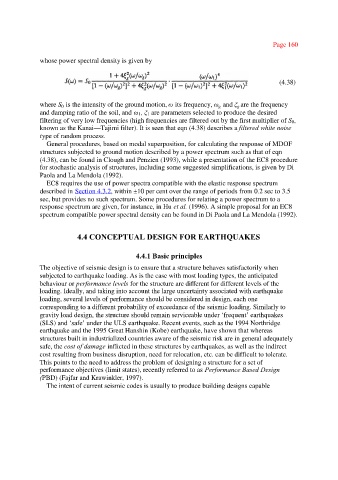
               whose power spectral density is given by


                                                                                                   (4.38)


               where S is the intensity of the ground motion, ωits frequency, ω and ξare the frequency
                                                                              g
                       0
                                                                                    g
               and damping ratio of the soil, and ω 1, ξ 1 are parameters selected to produce the desired
               filtering of very low frequencies (high frequencies are filtered out by the first multiplier of S0,
               known as the Kanai—Tajimi filter). It is seen that eqn (4.38) describes a filtered white noise
               type of random process.
                 General procedures, based on modal superposition, for calculating the response of MDOF
               structures subjected to ground motion described by a power spectrum such as that of eqn
               (4.38), can be found in Clough and Penzien (1993), while a presentation of the EC8 procedure
               for stochastic analysis of structures, including some suggested simplifications, is given by Di
               Paola and La Mendola (1992).
                 EC8 requires the use of power spectra compatible with the elastic response spectrum
               described in Section 4.3.2, within ±10 per cent over the range of periods from 0.2 sec to 3.5
               sec, but provides no such spectrum. Some procedures for relating a power spectrum to a
               response spectrum are given, for instance, in Hu et al. (1996). A simple proposal for an EC8
               spectrum compatible power spectral density can be found in Di Paola and La Mendola (1992).


                            4.4 CONCEPTUAL DESIGN FOR EARTHQUAKES


                                                 4.4.1 Basic principles

               The objective of seismic design is to ensure that a structure behaves satisfactorily when
               subjected to earthquake loading. As is the case with most loading types, the anticipated
               behaviour or performance levels for the structure are different for different levels of the
               loading. Ideally, and taking into account the large uncertainty associated with earthquake
               loading, several levels of performance should be considered in design, each one
               corresponding to a different probability of exceedance of the seismic loading. Similarly to
               gravity load design, the structure should remain serviceable under ‘frequent’ earthquakes
               (SLS) and ‘safe’ under the ULS earthquake. Recent events, such as the 1994 Northridge
               earthquake and the 1995 Great Hanshin (Kobe) earthquake, have shown that whereas
               structures built in industrialized countries aware of the seismic risk are in general adequately
               safe, the cost of damage inflicted in these structures by earthquakes, as well as the indirect
               cost resulting from business disruption, need for relocation, etc. can be difficult to tolerate.
               This points to the need to address the problem of designing a structure for a set of
               performance objectives (limit states), recently referred to as Performance Based Design
               (PBD) (Fajfar and Krawinkler, 1997).
                 The intent of current seismic codes is usually to produce building designs capable

