


Page 188 - Dynamic Loading and Design of Structures
P. 188
Page 163


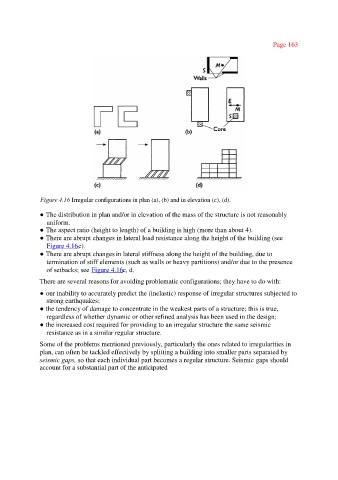
               Figure 4.16 Irregular configurations in plan (a), (b) and in elevation (c), (d).

               ●The distribution in plan and/or in elevation of the mass of the structure is not reasonably
                 uniform.
               ●The aspect ratio (height to length) of a building is high (more than about 4).
               ●There are abrupt changes in lateral load resistance along the height of the building (see
                 Figure 4.16c).
               ●There are abrupt changes in lateral stiffness along the height of the building, due to
                 termination of stiff elements (such as walls or heavy partitions) and/or due to the presence
                 of setbacks; see Figure 4.16c, d.

               There are several reasons for avoiding problematic configurations; they have to do with:
               ●our inability to accurately predict the (inelastic) response of irregular structures subjected to
                 strong earthquakes;
               ●the tendency of damage to concentrate in the weakest parts of a structure; this is true,
                 regardless of whether dynamic or other refined analysis has been used in the design;
               ●the increased cost required for providing to an irregular structure the same seismic
                 resistance as in a similar regular structure.
               Some of the problems mentioned previously, particularly the ones related to irregularities in
               plan, can often be tackled effectively by splitting a building into smaller parts separated by
               seismic gaps, so that each individual part becomes a regular structure. Seismic gaps should
               account for a substantial part of the anticipated

