


Page 193 - Dynamic Loading and Design of Structures
P. 193
Page 168


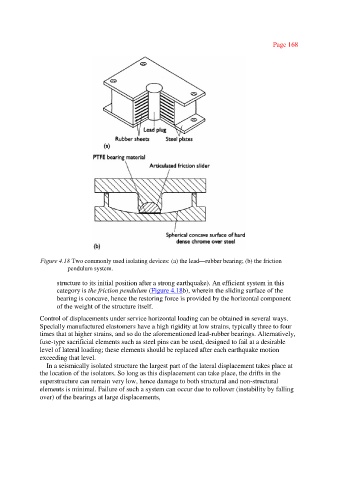
               Figure 4.18 Two commonly used isolating devices: (a) the lead—rubber bearing; (b) the friction
                         pendulum system.

                     structure to its initial position after a strong earthquake). An efficient system in this
                     category is the friction pendulum (Figure 4.18b), wherein the sliding surface of the
                     bearing is concave, hence the restoring force is provided by the horizontal component
                     of the weight of the structure itself.

               Control of displacements under service horizontal loading can be obtained in several ways.
               Specially manufactured elastomers have a high rigidity at low strains, typically three to four
               times that at higher strains, and so do the aforementioned lead-rubber bearings. Alternatively,
               fuse-type sacrificial elements such as steel pins can be used, designed to fail at a desirable
               level of lateral loading; these elements should be replaced after each earthquake motion
               exceeding that level.
                 In a seismically isolated structure the largest part of the lateral displacement takes place at
               the location of the isolators. So long as this displacement can take place, the drifts in the
               superstructure can remain very low, hence damage to both structural and non-structural
               elements is minimal. Failure of such a system can occur due to rollover (instability by falling
               over) of the bearings at large displacements,

