


Page 190 - Dynamic Loading and Design of Structures
P. 190
Page 165


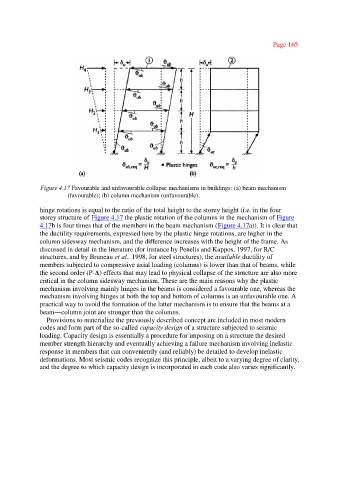
               Figure 4.17 Favourable and unfavourable collapse mechanisms in buildings: (a) beam mechanism
                         (favourable); (b) column mechanism (unfavourable).

               hinge rotations is equal to the ratio of the total height to the storey height (i.e. in the four
               storey structure of Figure 4.17 the plastic rotation of the columns in the mechanism of Figure
               4.17b is four times that of the members in the beam mechanism (Figure 4.17a)). It is clear that
               the ductility requirements, expressed here by the plastic hinge rotations, are higher in the
               column sidesway mechanism, and the difference increases with the height of the frame. As
               discussed in detail in the literature (for instance by Penelis and Kappos, 1997, for R/C
               structures, and by Bruneau et al., 1998, for steel structures), the available ductility of
               members subjected to compressive axial loading (columns) is lower than that of beams, while
                                    )
               the second order (P-Δ effects that may lead to physical collapse of the structure are also more
               critical in the column sidesway mechanism. These are the main reasons why the plastic
               mechanism involving mainly hinges in the beams is considered a favourable one, whereas the
               mechanism involving hinges at both the top and bottom of columns is an unfavourable one. A
               practical way to avoid the formation of the latter mechanism is to ensure that the beams at a
               beam—column joint are stronger than the columns.
                 Provisions to materialize the previously described concept are included in most modern
               codes and form part of the so-called capacity design of a structure subjected to seismic
               loading. Capacity design is essentially a procedure for imposing on a structure the desired
               member strength hierarchy and eventually achieving a failure mechanism involving inelastic
               response in members that can conveniently (and reliably) be detailed to develop inelastic
               deformations. Most seismic codes recognize this principle, albeit to a varying degree of clarity,
               and the degree to which capacity design is incorporated in each code also varies significantly.

