


Page 182 - Dynamic Loading and Design of Structures
P. 182
Page 157

               are ground motion dependent only (i.e. they are not correlated in any way to the
               characteristics of the structure to be designed).
                 A sensible choice of scaling parameters accounting for the characteristics of both the record
               and the structure, are the spectral values, either those of the response spectrum or of the
               Fourier spectrum. Since spectral ordinates vary with T, a critical question is which range of
               the spectra should be considered for deriving a scaling parameter. An early (1952), but still
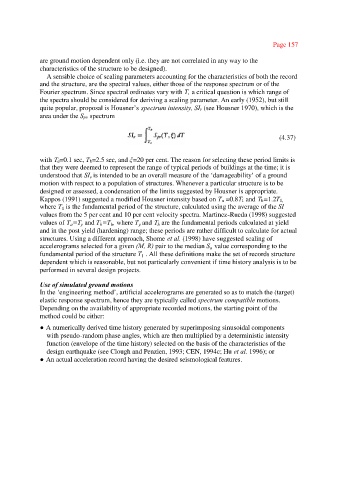
               quite popular, proposal is Housner’s spectrum intensity, SI v (see Housner 1970), which is the
               area under the Spv spectrum


                                                                                                   (4.37)


               with T a=0.1 sec, Tb=2.5 sec, and ξ=20 per cent. The reason for selecting these period limits is
               that they were deemed to represent the range of typical periods of buildings at the time; it is
               understood that SI is intended to be an overall measure of the ‘damageability’ of a ground
                                 v
               motion with respect to a population of structures. Whenever a particular structure is to be
               designed or assessed, a condensation of the limits suggested by Housner is appropriate.
               Kappos (1991) suggested a modified Housner intensity based on Ta =0.8T 1 and T b=1.2T1,
               where T is the fundamental period of the structure, calculated using the average of the SI
                       1
               values from the 5 per cent and 10 per cent velocity spectra. Martinez-Rueda (1998) suggested
               values of T =T and T =T , where T and T are the fundamental periods calculated at yield
                                                        b
                                        h
                                                  y
                          a
                                    b
                             y
               and in the post yield (hardening) range; these periods are rather difficult to calculate for actual
               structures. Using a different approach, Shome et al. (1998) have suggested scaling of
               accelerograms selected for a given (M, R) pair to the median S value corresponding to the
                                                                           a
               fundamental period of the structure T . All these definitions make the set of records structure
                                                   1
               dependent which is reasonable, but not particularly convenient if time history analysis is to be
               performed in several design projects.
               Use of simulated ground motions
               In the ‘engineering method’, artificial accelerograms are generated so as to match the (target)
               elastic response spectrum, hence they are typically called spectrum compatible motions.
               Depending on the availability of appropriate recorded motions, the starting point of the
               method could be either:

               ●A numerically derived time history generated by superimposing sinusoidal components
                 with pseudo-random phase angles, which are then multiplied by a deterministic intensity
                 function (envelope of the time history) selected on the basis of the characteristics of the
                 design earthquake (see Clough and Penzien, 1993; CEN, 1994c; Hu et al. 1996); or
               ●An actual acceleration record having the desired seismological features.

