


Page 178 - Dynamic Loading and Design of Structures
P. 178
Page 153

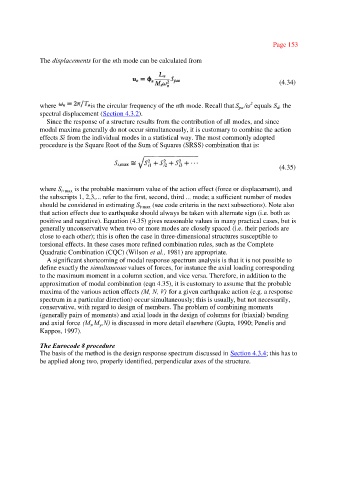
               The displacements for the nth mode can be calculated from


                                                                                                   (4.34)


                                                                                         2
               where             is the circular frequency of the nth mode. Recall that S /ω equals S , the
                                                                                     pa
                                                                                                  d
               spectral displacement (Section 4.3.2).
                 Since the response of a structure results from the contribution of all modes, and since
               modal maxima generally do not occur simultaneously, it is customary to combine the action
               effects Si from the individual modes in a statistical way. The most commonly adopted
               procedure is the Square Root of the Sum of Squares (SRSS) combination that is:


                                                                                                   (4.35)


               where S ,   is the probable maximum value of the action effect (force or displacement), and
                       i max
               the subscripts 1, 2,3,... refer to the first, second, third ... mode; a sufficient number of modes
               should be considered in estimating S ,  (see code criteria in the next subsections). Note also
                                                  i max
               that action effects due to earthquake should always be taken with alternate sign (i.e. both as
               positive and negative). Equation (4.35) gives reasonable values in many practical cases, but is
               generally unconservative when two or more modes are closely spaced (i.e. their periods are
               close to each other); this is often the case in three-dimensional structures susceptible to
               torsional effects. In these cases more refined combination rules, such as the Complete
               Quadratic Combination (CQC) (Wilson et al., 1981) are appropriate.
                 A significant shortcoming of modal response spectrum analysis is that it is not possible to
               define exactly the simultaneous values of forces, for instance the axial loading corresponding
               to the maximum moment in a column section, and vice versa. Therefore, in addition to the
               approximation of modal combination (eqn 4.35), it is customary to assume that the probable
               maxima of the various action effects (M, N, V) for a given earthquake action (e.g. a response
               spectrum in a particular direction) occur simultaneously; this is usually, but not necessarily,
               conservative, with regard to design of members. The problem of combining moments
               (generally pairs of moments) and axial loads in the design of columns for (biaxial) bending
               and axial force (M ,M ,N) is discussed in more detail elsewhere (Gupta, 1990; Penelis and
                                    y
                                 x
               Kappos, 1997).
               The Eurocode 8 procedure
               The basis of the method is the design response spectrum discussed in Section 4.3.4; this has to
               be applied along two, properly identified, perpendicular axes of the structure.

