


Page 173 - Dynamic Loading and Design of Structures
P. 173
Page 149


                                      4.3.5 Equivalent lateral force procedures

               Until very recently seismic design of most structures was based on a static analysis using a set
               of lateral (horizontal) forces assumed to represent the actual (dynamic) earthquake loading. In
               the absence of commercial software appropriate for dynamic analysis of three-dimensional
               structures, as well as of the expertise for using whatever software of this type was available,
               most codes of practice clearly promoted the simpler static procedure. However, the last 10 to
               15 years were marked by a massive introduction of more advanced software packages,
               running on increasingly more powerful hardware; this was probably the main reason for a
               change of attitude, both from the practising engineer’s and the code drafter’s point of view.
               As a consequence, in modern codes, such as the EC8, dynamic analysis (Section 4.3.6) is
               adopted as the reference method, and its application is compulsory in many cases of practical
               interest.
                 The typical procedure in the equivalent static analysis method is the determination of an
               appropriate value of the base shear in terms of the structure mass and the design earthquake
               intensity, properly reduced for inelastic effects, along the lines discussed in the previous
               section. The base shear is then used for estimating a set of lateral forces distributed along the
               structure following (more or less) the fundamental mode of vibration. Since the base shear
               itself is also calculated on the basis of the fundamental period, it is clear that the application
               of the equivalent lateral force method should be restricted to structures whose dynamic
               response is governed by the fundamental mode.


               The Eurocode 8 procedure
               The method is referred to as ‘simplified modal response spectrum analysis’, rather than as
               ‘equivalent static analysis’, and is restricted to structures that are not significantly affected by
               higher modes and/or stiffness irregularities.
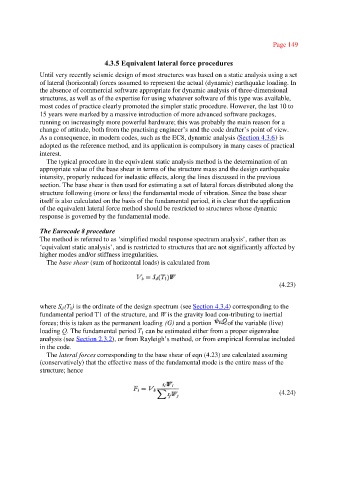
                 The base shear (sum of horizontal loads) is calculated from


                                                                                                   (4.23)


               where S (T ) is the ordinate of the design spectrum (see Section 4.3.4) corresponding to the
                          1
                       d
               fundamental period T1 of the structure, and W is the gravity load con-tributing to inertial
               forces; this is taken as the permanent loading (G) and a portion  of the variable (live)
               loading Q. The fundamental period T can be estimated either from a proper eigenvalue
                                                   1
               analysis (see Section 2.3.2), or from Rayleigh’s method, or from empirical formulae included
               in the code.
                 The lateral forces corresponding to the base shear of eqn (4.23) are calculated assuming
               (conservatively) that the effective mass of the fundamental mode is the entire mass of the
               structure; hence


                                                                                                   (4.24)

