


Page 171 - Dynamic Loading and Design of Structures
P. 171
Page 147

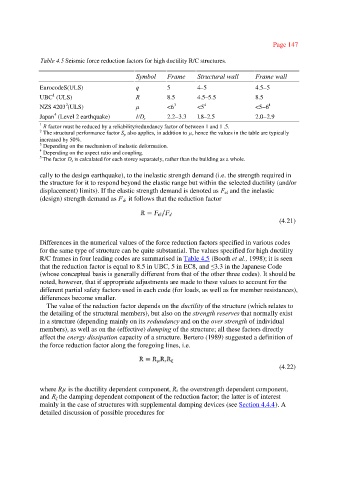
               Table 4.5 Seismic force reduction factors for high ductility R/C structures.


                                                 Symbol     Frame     Structural wall      Frame wall
               EurocodeS(ULS)                    q          5         4–5                  4.5–5
                    1
               UBC (ULS)                         R          8.5       4.5–5.5              8.5
                        2
               NZS 4203 (ULS)                    µ          <6 3      <5 4                 <5–6 4
                    4
               Japan (Level 2 earthquake)        I/D s      2.2–3.3   l.8–2.5              2.0–2.9
               1
                R factor must be reduced by a reliability/redundancy factor of between 1 and 1 .5.
               2  The structural performance factor S also applies, in addition to µ, hence the values in the table are typically
                                             p
               increased by 50%.
               3  Depending on the mechanism of inelastic deformation.
               4
                Depending on the aspect ratio and coupling.
               5  The factor D is calculated for each storey separately, rather than the building as a whole.
                          s
               cally to the design earthquake), to the inelastic strength demand (i.e. the strength required in
               the structure for it to respond beyond the elastic range but within the selected ductility (and/or
               displacement) limits). If the elastic strength demand is denoted as F and the inelastic
                                                                                el
               (design) strength demand as F , it follows that the reduction factor
                                            d


                                                                                                   (4.21)


               Differences in the numerical values of the force reduction factors specified in various codes
               for the same type of structure can be quite substantial. The values specified for high ductility
               R/C frames in four leading codes are summarised in Table 4.5 (Booth et al., 1998); it is seen
               that the reduction factor is equal to 8.5 in UBC, 5 in EC8, and ≤3.3 in the Japanese Code
               (whose conceptual basis is generally different from that of the other three codes). It should be
               noted, however, that if appropriate adjustments are made to these values to account for the
               different partial safety factors used in each code (for loads, as well as for member resistances),
               differences become smaller.
                 The value of the reduction factor depends on the ductility of the structure (which relates to
               the detailing of the structural members), but also on the strength reserves that normally exist
               in a structure (depending mainly on its redundancy and on the over strength of individual
               members), as well as on the (effective) damping of the structure; all these factors directly
               affect the energy dissipation capacity of a structure. Bertero (1989) suggested a definition of
               the force reduction factor along the foregoing lines, i.e.


                                                                                                   (4.22)


               where Rµ is the ductility dependent component, Rs the overstrength dependent component,
               and R the damping dependent component of the reduction factor; the latter is of interest
                     ξ
               mainly in the case of structures with supplemental damping devices (see Section 4.4.4). A
               detailed discussion of possible procedures for

