


Page 168 - Dynamic Loading and Design of Structures
P. 168
Page 144

                 Newmark and Hall (1982) have noted the following characteristics of inelastic response
               spectra:

               ●For periods longer than about 0.5 sec, the displacements of the inelastic systems are very
                 close to those of the elastic systems; referring to Figure 4.13, it can be shown that in this
                 case the yield force in the inelastic system is Fy=Fel/µ, where Fel is the force in the elastic
                 system corresponding to the displacement umax. Given that the maximum force in an
                 elastoplastic system is its mass times the pseudo-acceleration (F =mS ) the corresponding
                                                                               y
                                                                                    pa
                 R-factor defined from eqn (4.19) is in this case constant (i.e. R=µ).
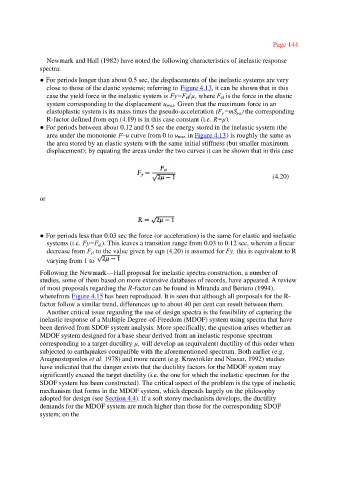
               ●For periods between about 0.12 and 0.5 sec the energy stored in the inelastic system (the
                 area under the monotonie F–u curve from 0 to umax in Figure 4.13) is roughly the same as
                 the area stored by an elastic system with the same initial stiffness (but smaller maximum
                 displacement); by equating the areas under the two curves it can be shown that in this case


                                                                                                 (4.20)


               or


               ●For periods less than 0.03 sec the force (or acceleration) is the same for elastic and inelastic
                 systems (i.e. Fy=F ). This leaves a transition range from 0.03 to 0.12 sec, wherein a linear
                                    el
                 decrease from F to the value given by eqn (4.20) is assumed for Fy, this is equivalent to R
                                 el
                 varying from 1 to

               Following the Newmark—Hall proposal for inelastic spectra construction, a number of
               studies, some of them based on more extensive databases of records, have appeared. A review
               of most proposals regarding the R-factor can be found in Miranda and Bertero (1994),
               wherefrom Figure 4.15 has been reproduced. It is seen that although all proposals for the R-
               factor follow a similar trend, differences up to about 40 per cent can result between them.
                 Another critical issue regarding the use of design spectra is the feasibility of capturing the
               inelastic response of a Multiple Degree-of-Freedom (MDOF) system using spectra that have
               been derived from SDOF system analysis. More specifically, the question arises whether an
               MDOF system designed for a base shear derived from an inelastic response spectrum
               corresponding to a target ductility µ, will develop an (equivalent) ductility of this order when
               subjected to earthquakes compatible with the aforementioned spectrum. Both earlier (e.g.
               Anagnostopoulos et al. 1978) and more recent (e.g. Krawinkler and Nassar, 1992) studies
               have indicated that the danger exists that the ductility factors for the MDOF system may
               significantly exceed the target ductility (i.e. the one for which the inelastic spectrum for the
               SDOF system has been constructed). The critical aspect of the problem is the type of inelastic
               mechanism that forms in the MDOF system, which depends largely on the philosophy
               adopted for design (see Section 4.4). If a soft storey mechanism develops, the ductility
               demands for the MDOF system are much higher than those for the corresponding SDOF
               system; on the

