


Page 164 - Dynamic Loading and Design of Structures
P. 164
Page 140

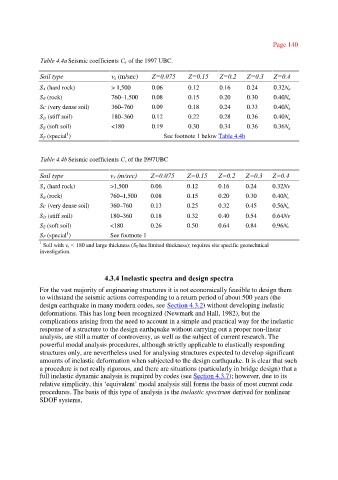
               Table 4.4a Seismic coefficients C a of the 1997 UBC.


               Soil type                v (m/sec)     Z=0.075      Z=0.15     Z=0.2     Z=0.3    Z=0.4
                                         s
               S A (hard rock)          > 1,500       0.06         0.12       0.16      0.24     0.32N a
               S B (rock)               760–1,500     0.08         0.15       0.20      0.30     0.40N a

               Sc (very dense soil)     360–760       0.09         0.18       0.24      0.33     0.40N a
               S (stiff soil)           180–360       0.12         0.22       0.28      0.36     0.40N a
                D
               S (soft soil)            <180          0.19         0.30       0.34      0.36     0.36N a
                E
                        1
               S (special )                                See footnote 1 below Table 4.4b
                F

               Table 4.4b Seismic coefficients C of the I997UBC
                                             v

               Soil type                v s (m/sec)   Z=0.075      Z=0.15     Z=0.2    Z=0.3     Z=0.4
               S (hard rock)            >1,500        0.06         0.12       0.16     0.24      0.32Nv
                A
               S (rock)                 760–1,500     0.08         0.15       0.20     0.30      0.40N v
                B
               Sc (very dense soil)     360–760       0.13         0.25       0.32     0.45      0.56N v
               S D (stiff soil)         180–360       0.18         0.32       0.40     0.54      0.64Nv

               S E (soft soil)          <180          0.26         0.50       0.64     0.84      0.96N v
                        1
               S F (special )           See footnote 1
               1
                Soil with v s < 180 and large thickness (S E has limited thickness); requires site specific geotechnical
               investigation.


                                      4.3.4 Inelastic spectra and design spectra

               For the vast majority of engineering structures it is not economically feasible to design them
               to withstand the seismic actions corresponding to a return period of about 500 years (the
               design earthquake in many modern codes, see Section 4.3.2) without developing inelastic
               deformations. This has long been recognized (Newmark and Hall, 1982), but the
               complications arising from the need to account in a simple and practical way for the inelastic
               response of a structure to the design earthquake without carrying out a proper non-linear
               analysis, are still a matter of controversy, as well as the subject of current research. The
               powerful modal analysis procedures, although strictly applicable to elastically responding
               structures only, are nevertheless used for analysing structures expected to develop significant
               amounts of inelastic deformation when subjected to the design earthquake. It is clear that such
               a procedure is not really rigorous, and there are situations (particularly in bridge design) that a
               full inelastic dynamic analysis is required by codes (see Section 4.3.7); however, due to its
               relative simplicity, this ‘equivalent’ modal analysis still forms the basis of most current code
               procedures. The basis of this type of analysis is the inelastic spectrum derived for nonlinear
               SDOF systems,

