


Page 160 - Dynamic Loading and Design of Structures
P. 160
Page 136

                 As mentioned previously, the design PGA (α g ) corresponds to a 10 per cent probability of
               being exceeded in 50 years (or a return period of 475 years). This is the suggested probability
               for usual structures; for important structures, such as critical facilities, which should remain
               operational following the earthquake, lower probabilities of exceedance are appropriate. This
               is treated in a simple way in EC8 by specifying an importance factor γwhich multiplies the
                                                                                   I
               seismic action (see eqn 4.29 in Section 4.3.5). For buildings γ I ranges from 0.8 to 1.4, where
               the highest value corresponds to buildings of vital importance for civil protection (hospitals,
               power plants, fire stations), and the lowest value to buildings of minor importance (e.g.
               agricultural).
                 For the vertical response spectrum, EC8 recommends the use of the previously described
               spectrum for the horizontal motion, with the following modifications:
               ●for periods T≤0.15 sec the ordinates of the spectrum are multiplied by a factor of 0.7;
               ●for periods T≥0.50 sec the ordinates of the spectrum are multiplied by a factor of 0.5;
               ●for 0.15<T<0.50 sec linear interpolation is used.

               As mentioned in Section 4.2.3, the       factor is a reasonable value for the vertical to
               horizontal PGA ratio, but at distances from the source less than about 15km it may exceed
               unity. The corresponding spectral acceleration ratios may also exceed one in the near field,
               but are typically less than one for intermediate and long periods (Ambraseys and Simpson,
               1996).
                 The response spectrum specified in the American Uniform Building Code, UBC
               (International Conference of Building Officials, 1997) is similar to the first three branches of
               the Eurocode 8 spectrum. The ascending part starts from a value Ca, representing the design
               EPA value, while the flat part corresponds to a value of 2.5C a, exactly as in the Eurocode. The
               exponential branch is defined by C /T, where C is an EPV dependent coefficient, identical to
                                                 v
                                                             v
               C for rock sites but higher for soil sites (C and C are given in Table 4.4 of the next section).
                 a
                                                               v
                                                        a
               The corner periods (see points B and C in Figure 4.11) in the UBC spectrum are Tc=Cv/2.5Ca
               and T B=0.2TC.
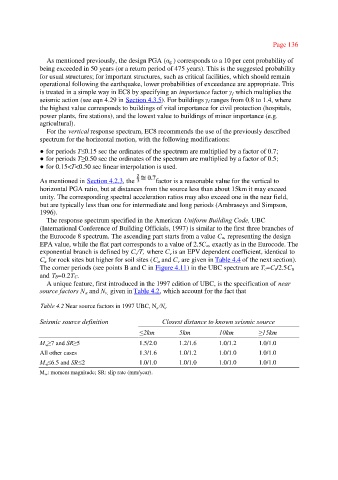
                 A unique feature, first introduced in the 1997 edition of UBC, is the specification of near
               source factors N and N given in Table 4.2, which account for the fact that
                               a
                                      v,
               Table 4.2 Near source factors in 1997 UBC, N /N .
                                                        a
                                                           v
               Seismic source definition                  Closest distance to known seismic source
                                                  ≤2km          5km           10km          ≥15km
               M ≥7 and SR≥5                      1.5/2.0       1.2/1.6       1.0/1.2       1.0/1.0
                 w
               All other cases                    1.3/1.6       1.0/1.2       1.0/1.0       1.0/1.0

               M ≤6.5 and SR≤2                    1.0/1.0       1.0/1.0       1.0/1.0       1.0/1.0
                 w
               M : moment magnitude; SR: slip rate (mm/year).
                 w

