


Page 157 - Dynamic Loading and Design of Structures
P. 157
Page 133

                 It is common to use amplification factors at the 84 percentile level with mean or median
               values of A, V, and D (Clough and Penzien, 1993).
                 The above method, which has influenced substantially the development of US and other
               codes, has the weakness that it ignores the fact that the spectral displacement tends to the
               PGD for very flexible structures (period tending to infinity). Until recently this had no
               practical consequences; however, in the case of displacement based design procedures which
               assume that structures respond well into the inelastic range (hence their effective periods can
               be quite long), an additional transition curve between the amplified displacement line and the
               constant PGD line might be necessary.
                 As an alternative to anchoring a fixed shape to a PGA and other ground motion parameters,
               spectra corresponding to a uniform probability of exceedance of their ordinates (uniform
               hazard spectra) can be constructed, as briefly discussed in Section 4.2.5. The effort required
               for their development is significantly higher than that associated with the previously described
               method.

               Code spectra
               Seismic codes typically specify pseudo-acceleration spectra only, consisting of a fixed shape
               to be anchored to a (design) PGA. Starting from the design PGA, it has long been argued that
               this should not correspond to the actually recorded peak acceleration, which might be
               associated with very short duration and high frequency pulses of the record, but should rather
               be representative of the effect of the acceleration on the structure. Hence, the concept of
               Effective PGA (usually denoted as EPA or Aef) has been suggested. EPA can be calculated
               from the 5 per cent damping Spa value in the region 0.1 to 0.5 sec, by dividing the average
               ordinate by an amplification factor of 2.5 (see Commentary to FEMA, 1995). The EPA is not
               the same as the PGA, and in fact when acceleration peaks are associated with very high
               frequencies, the EPA can be significantly lower than the PGA. The 1994 NEHRP Provisions
               (FEMA, 1995) also introduce the concepts of effective PGV (denoted as EPV) and the
               corresponding velocity related acceleration, which might control the design of longer period
               structures.
                 An indication of the uncertainty in the shape of the response spectrum is the difference
               between the median and 84 percentile values of the amplification factors given in Table 4.1;
               note that the coefficient of variation is higher for Spv than for Spa. It is worth pointing out that
               these high coefficients of variation were calculated for ground motions from one particular
               area (Western US) (i.e. for essentially the same geological and tectonic conditions).
                 A typical example of a code specified spectrum is shown in Figure 4.11, where the 5 per
               cent-damped elastic pseudo-acceleration spectrum of Eurocode 8 (CEN, 1994a) is plotted.
               The spectrum consists of four branches:
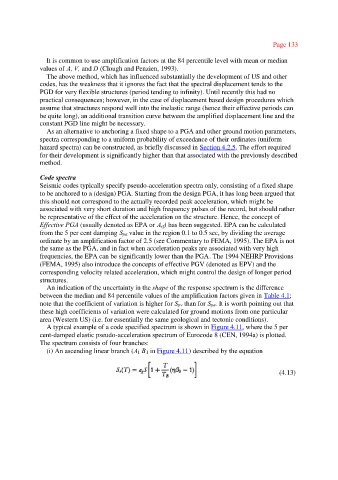
                 (i) An ascending linear branch (A1 B1 in Figure 4.11) described by the equation


                                                                                                   (4.13)

