


Page 159 - Dynamic Loading and Design of Structures
P. 159
Page 135


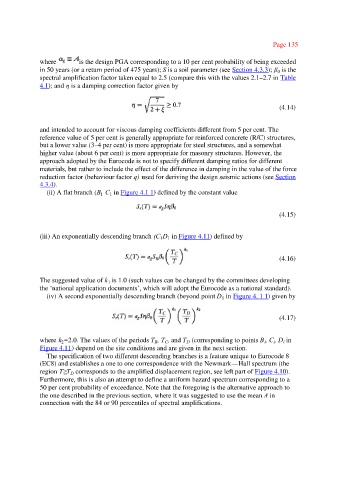
               where         is the design PGA corresponding to a 10 per cent probability of being exceeded
               in 50 years (or a return period of 475 years); S is a soil parameter (see Section 4.3.3); βis the
                                                                                                   0
               spectral amplification factor taken equal to 2.5 (compare this with the values 2.1–2.7 in Table
               4.1); and ηis a damping correction factor given by


                                                                                                   (4.14)


               and intended to account for viscous damping coefficients different from 5 per cent. The
               reference value of 5 per cent is generally appropriate for reinforced concrete (R/C) structures,
               but a lower value (3–4 per cent) is more appropriate for steel structures, and a somewhat
               higher value (about 6 per cent) is more appropriate for masonry structures. However, the
               approach adopted by the Eurocode is not to specify different damping ratios for different
               materials, but rather to include the effect of the difference in damping in the value of the force
               reduction factor (behaviour factor q) used for deriving the design seismic actions (see Section
               4.3.4).
                 (ii) A flat branch (B C in Figure 4.1 1) defined by the constant value
                                    1
                                        1

                                                                                                   (4.15)


               (iii) An exponentially descending branch (C D in Figure 4.11) defined by
                                                         1
                                                            1

                                                                                                   (4.16)


               The suggested value of k is 1.0 (such values can be changed by the committees developing
                                       1
               the ‘national application documents’, which will adopt the Eurocode as a national standard).
                 (iv) A second exponentially descending branch (beyond point D in Figure 4. 1 1) given by
                                                                               1


                                                                                                   (4.17)


               where k =2.0. The values of the periods T , T , and T (corresponding to points B , C , D in
                                                                                                 i
                                                                   D
                                                                                              i
                                                           C
                       2
                                                                                                     i
                                                       B
               Figure 4.11) depend on the site conditions and are given in the next section.
                 The specification of two different descending branches is a feature unique to Eurocode 8
               (EC8) and establishes a one to one correspondence with the Newmark—Hall spectrum (the
               region T≥T corresponds to the amplified displacement region, see left part of Figure 4.10).
                          D
               Furthermore, this is also an attempt to define a uniform hazard spectrum corresponding to a
               50 per cent probability of exceedance. Note that the foregoing is the alternative approach to
               the one described in the previous section, where it was suggested to use the mean A in
               connection with the 84 or 90 percentiles of spectral amplifications.

