


Page 177 - Dynamic Loading and Design of Structures
P. 177
Page 152

               where Eh is the load due to the horizontal component (corresponding to the base shear of eqn
               4.27), ρis the redundancy factor described previously, and Ev is the load effect resulting from
               the vertical component of the ground motion, accounted for by adding an extra permanent
               load (additional to G), equal to 0.5C IG. This is an interesting difference between the two
                                                  a
               codes, since EC8 requires consideration of the vertical component in special cases only (i.e.
               horizontal cantilever members, long span (>20 m) members, prestressed concrete members,
               and beams supporting columns); in all these cases the vertical component can be considered
               locally (for the members under consideration and their associated supporting members).


                                           4.3.6 Modal analysis procedures

               For the purposes of seismic design the method is almost invariably applied in combination
               with the design response spectrum, and is typically referred to as ‘modal response spectrum
               analysis’. Its field of applicability covers essentially all cases for which the equivalent static
               analysis is not appropriate (i.e. cases where modes other than the fundamental one affect
               significantly the response of the structure). There are a few cases where modal analysis is not
               deemed appropriate and a full dynamic (time history) analysis is required, a notable example
               being the design of base isolated bridges to EC8 Part 2 (CEN, 1994c). Detailed presentations
               of the modal response spectrum analysis can be found elsewhere (Gupta, 1990; Clough and
               Penzien, 1993; Chopra, 1995).

               Review of the procedure
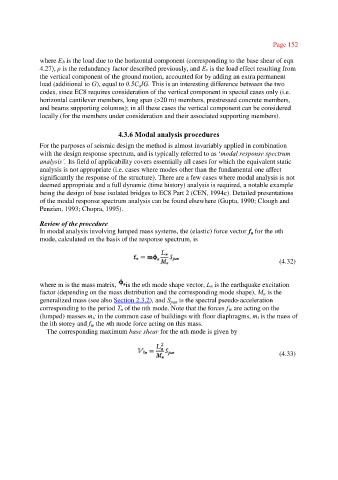
               In modal analysis involving lumped mass systems, the (elastic) force vector f for the nth
                                                                                         n
               mode, calculated on the basis of the response spectrum, is


                                                                                                   (4.32)


               where m is the mass matrix,   is the nth mode shape vector, Ln is the earthquake excitation
               factor (depending on the mass distribution and the corresponding mode shape), M is the
                                                                                              n
               generalized mass (see also Section 2.3.2), and S pan  is the spectral pseudo-acceleration
               corresponding to the period T n of the nth mode. Note that the forces fin are acting on the
               (lumped) masses mi; in the common case of buildings with floor diaphragms, mi is the mass of
               the ith storey and f the nth mode force acting on this mass.
                                 in
                 The corresponding maximum base shear for the nth mode is given by


                                                                                                   (4.33)

