


Page 179 - Dynamic Loading and Design of Structures
P. 179
Page 154

                 The criterion for the required number of modes to be included in the analysis is two-fold:

               ●the sum of the effective modal masses (        , see eqn 4.33) of the considered modes
                 should amount to at least 90 per cent of the total mass of the structure;
               ●all modes with effective mass greater than 5 per cent of the total mass should be considered.
               The modal action effects should be combined using the SRSS approach (eqn 4.35), unless the
               periods of two of the considered modes differ by less than 10 per cent, in which case the CQC
               approach should be used.
                 The accidental eccentricity e (eqn 4.25) could be considered in buildings either by
                                             1
               displacing the location of the mass of each storey diaphragm by e1 or (more conveniently) by
               introducing an equivalent torsional moment, exactly as in the case of equivalent static analysis.
                 The simultaneous action of the two horizontal components should be taken into account;
               this is also required in equivalent static analysis. Since peak values do not occur at the same
               time in both directions (x and y), the simultaneous action can be modelled either:

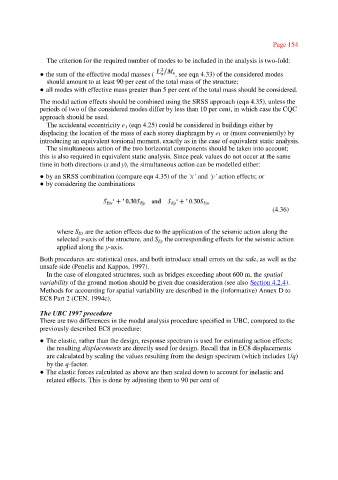
               ●by an SRSS combination (compare eqn 4.35) of the ‘x’ and ‘y’ action effects; or
               ●by considering the combinations


                                                                                                 (4.36)


                     where SEx are the action effects due to the application of the seismic action along the
                     selected x-axis of the structure, and S Ey  the corresponding effects for the seismic action
                     applied along the y-axis.

               Both procedures are statistical ones, and both introduce small errors on the safe, as well as the
               unsafe side (Penelis and Kappos, 1997).
                 In the case of elongated structures, such as bridges exceeding about 600 m, the spatial
               variability of the ground motion should be given due consideration (see also Section 4.2.4).
               Methods for accounting for spatial variability are described in the (informative) Annex D to
               EC8 Part 2 (CEN, 1994c).


               The UBC 1997 procedure
               There are two differences in the modal analysis procedure specified in UBC, compared to the
               previously described EC8 procedure:

               ●The elastic, rather than the design, response spectrum is used for estimating action effects;
                 the resulting displacements are directly used for design. Recall that in EC8 displacements
                 are calculated by scaling the values resulting from the design spectrum (which includes 1/q)
                 by the q-factor.
               ●The elastic forces calculated as above are then scaled down to account for inelastic and
                 related effects. This is done by adjusting them to 90 per cent of

