


Page 250 - Dynamic Loading and Design of Structures
P. 250
Page 221


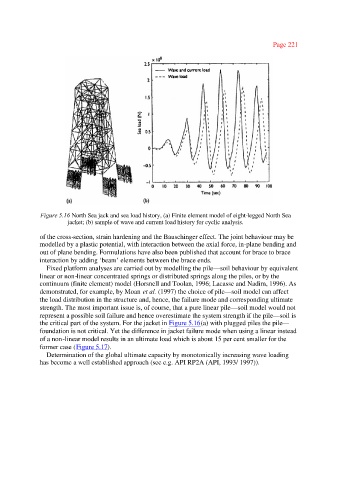
               Figure 5.16 North Sea jack and sea load history, (a) Finite element model of eight-legged North Sea
                         jacket; (b) sample of wave and current load history for cyclic analysis.

               of the cross-section, strain hardening and the Bauschinger effect. The joint behaviour may be
               modelled by a plastic potential, with interaction between the axial force, in-plane bending and
               out of plane bending. Formulations have also been published that account for brace to brace
               interaction by adding ‘beam’ elements between the brace ends.
                 Fixed platform analyses are carried out by modelling the pile—soil behaviour by equivalent
               linear or non-linear concentrated springs or distributed springs along the piles, or by the
               continuum (finite element) model (Horsnell and Toolan, 1996; Lacasse and Nadim, 1996). As
               demonstrated, for example, by Moan et al. (1997) the choice of pile—soil model can affect
               the load distribution in the structure and, hence, the failure mode and corresponding ultimate
               strength. The most important issue is, of course, that a pure linear pile—soil model would not
               represent a possible soil failure and hence overestimate the system strength if the pile—soil is
               the critical part of the system. For the jacket in Figure 5.16(a) with plugged piles the pile—
               foundation is not critical. Yet the difference in jacket failure mode when using a linear instead
               of a non-linear model results in an ultimate load which is about 15 per cent smaller for the
               former case (Figure 5.17).
                 Determination of the global ultimate capacity by monotonically increasing wave loading
               has become a well established approach (see e.g. API RP2A (API, 1993/ 1997)).

