


Page 319 - E-Bussiness and E-Commerce Management Strategy, Implementation, and Practice
P. 319
M05_CHAF9601_04_SE_C05.QXD:D01_CHAF7409_04_SE_C01.QXD  16/4/09  11:12  Page 286


                286  Part 2 Strategy and applications


                                                            Customers and markets
                                                                 Add value
                                        Organization C
                                                                                 Organization B


                                      Manage risks                                        Reduce costs
                                      Market, financial,                                  Transactions and
                                      legal, operational                                  processes
                                      risks


                                                                                    Organization A
                                       Each way of using information
                                       involves using different types of
                                       information
                                                              Create new reality
                                                              New products,
                                                              new services,
                                                              new business ideas

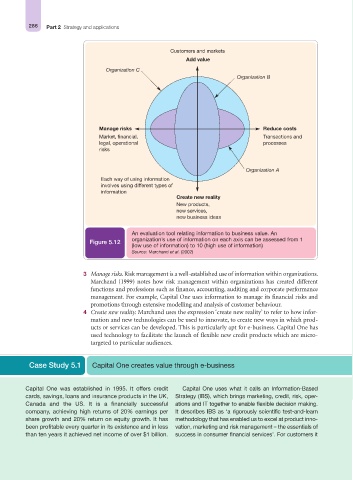
                                                An evaluation tool relating information to business value. An
                                                organization’s use of information on each axis can be assessed from 1
                                   Figure 5.12
                                                (low use of information) to 10 (high use of information)
                                                Source: Marchand et al. (2002)


                                 3 Manage risks. Risk management is a well-established use of information within organizations.
                                   Marchand (1999) notes how risk management within organizations has created different
                                   functions and professions such as finance, accounting, auditing and corporate performance
                                   management. For example, Capital One uses information to manage its financial risks and
                                   promotions through extensive modelling and analysis of customer behaviour.
                                 4 Create new reality. Marchand uses the expression ‘create new reality’ to refer to how infor-

                                   mation and new technologies can be used to innovate, to create new ways in which prod-
                                   ucts or services can be developed. This is particularly apt for e-business. Capital One has
                                   used technology to facilitate the launch of flexible new credit products which are micro-
                                   targeted to particular audiences.


                Case Study 5.1      Capital One creates value through e-business


               Capital One was established in 1995. It offers credit  Capital One uses what it calls an Information-Based
               cards, savings, loans and insurance products in the UK,  Strategy (IBS), which brings marketing, credit, risk, oper-
               Canada and the US. It is a financially successful  ations and IT together to enable flexible decision making.
               company, achieving high returns of 20% earnings per  It describes IBS as ‘a rigorously scientific test-and-learn
               share growth and 20% return on equity growth. It has  methodology that has enabled us to excel at product inno-
               been profitable every quarter in its existence and in less  vation, marketing and risk management – the essentials of
               than ten years it achieved net income of over $1 billion.  success in consumer financial services’. For customers it

