


Page 324 - E-Bussiness and E-Commerce Management Strategy, Implementation, and Practice
P. 324
M05_CHAF9601_04_SE_C05.QXD:D01_CHAF7409_04_SE_C01.QXD  16/4/09  11:12  Page 291


                                                                                 Chapter 5 E-business strategy  291


                       Box 5.5        Conversion modelling

                                      A widely quoted conceptual measurement framework based on the industrial
                                      marketing concepts of purchasing decision processes and hierarchy of effects models,
                                      which can be applied for conversion marketing, was proposed by Berthon et al. (1998).
                                      The model assesses efficiency of offline and online communications in drawing the
                                      prospect through different stages of the buying decision. The main measures defined
                                      in the model are the following ratios:
                                      1  Awareness efficiency: target web-users/all web-users.
                                      2  Locatability or attractability efficiency: number of individual visits/number of seekers.
                                      3  Contact efficiency: number of active visitors/number of visits.
                                      4  Conversion efficiency: number of purchases/number of active visits.
                                      5  Retention efficiency: number of repurchases/number of purchases.
                                      This model is instructive for improving Internet marketing within an organization since
                                      these different types of conversion efficiency are key to understanding how effective
                                      online and offline marketing communications are in achieving marketing outcomes.


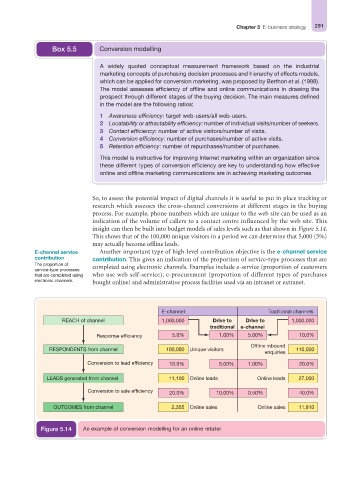
                                    So, to assess the potential impact of digital channels it is useful to put in place tracking or
                                    research which assesses the cross-channel conversions at different stages in the buying
                                    process. For example, phone numbers which are unique to the web site can be used as an
                                    indication of the volume of callers to a contact centre influenced by the web site. This
                                    insight can then be built into budget models of sales levels such as that shown in Figure 5.14.
                                    This shows that of the 100,000 unique visitors in a period we can determine that 5,000 (5%)
                                    may actually become offline leads.
                  E-channel service   Another important type of high-level contribution objective is the e-channel service
                  contribution      contribution. This gives an indication of the proportion of service-type processes that are
                  The proportion of  completed using electronic channels. Examples include e-service (proportion of customers
                  service-type processes
                  that are completed using  who use web self-service), e-procurement (proportion of different types of purchases
                  electronic channels.  bought online) and administrative process facilities used via an intranet or extranet.


                                                          E-channel                        Traditional channels
                          REACH of channel                1,000,000       Drive to  Drive to       1,000,000
                                                                         traditional  e-channel
                                     Response efficiency     5.0%           1.00%    5.00%           10.0%
                                                                                      Offline inbound
                      RESPONDENTS from channel             100,000  Unique visitors                 110,000
                                                                                          enquiries
                                  Conversion to lead efficiency  10.0%      5.00%    1.00%           20.0%


                      LEADS generated from channel          11,100  Online leads        Online leads  27,000
                                  Conversion to sale efficiency  20.0%     10.00%    0.50%           40.0%

                        OUTCOMES from channel                2,355  Online sales        Online sales  11,910


                    Figure 5.14  An example of conversion modelling for an online retailer

