


Page 329 - E-Bussiness and E-Commerce Management Strategy, Implementation, and Practice
P. 329
M05_CHAF9601_04_SE_C05.QXD:D01_CHAF7409_04_SE_C01.QXD  16/4/09  11:12  Page 296


                296  Part 2 Strategy and applications


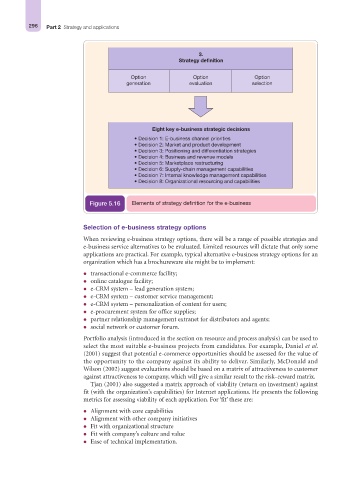
                                                                     3.
                                                               Strategy definition

                                                Option              Option             Option
                                               generation         evaluation          selection


                                                       Eight key e-business strategic decisions
                                                 • Decision 1: E-business channel priorities
                                                 • Decision 2: Market and product development
                                                 • Decision 3: Positioning and differentiation strategies
                                                 • Decision 4: Business and revenue models
                                                 • Decision 5: Marketplace restructuring
                                                 • Decision 6: Supply-chain management capabilities
                                                 • Decision 7: Internal knowledge management capabilities
                                                 • Decision 8: Organizational resourcing and capabilities


                                   Figure 5.16  Elements of strategy definition for the e-business


                                 Selection of e-business strategy options
                                 When reviewing e-business strategy options, there will be a range of possible strategies and
                                 e-business service alternatives to be evaluated. Limited resources will dictate that only some
                                 applications are practical. For example, typical alternative e-business strategy options for an
                                 organization which has a brochureware site might be to implement:
                                   transactional e-commerce facility;
                                   online catalogue facility;
                                   e-CRM system – lead generation system;
                                   e-CRM system – customer service management;
                                   e-CRM system – personalization of content for users;
                                   e-procurement system for office supplies;

                                   partner relationship management extranet for distributors and agents;
                                   social network or customer forum.

                                 Portfolio analysis (introduced in the section on resource and process analysis) can be used to
                                 select the most suitable e-business projects from candidates. For example, Daniel et al.
                                 (2001) suggest that potential e-commerce opportunities should be assessed for the value of
                                 the opportunity to the company against its ability to deliver. Similarly, McDonald and
                                 Wilson (2002) suggest evaluations should be based on a matrix of attractiveness to customer
                                 against attractiveness to company, which will give a similar result to the risk–reward matrix.
                                   Tjan (2001) also suggested a matrix approach of viability (return on investment) against
                                 fit (with the organization’s capabilities) for Internet applications. He presents the following
                                 metrics for assessing viability of each application. For ‘fit’ these are:
                                   Alignment with core capabilities
                                   Alignment with other company initiatives
                                   Fit with organizational structure
                                   Fit with company’s culture and value
                                   Ease of technical implementation.

