


Page 332 - E-Bussiness and E-Commerce Management Strategy, Implementation, and Practice
P. 332
M05_CHAF9601_04_SE_C05.QXD:D01_CHAF7409_04_SE_C01.QXD  16/4/09  11:12  Page 299


                                                                                 Chapter 5 E-business strategy  299


                                    from the sales person. Companies selling mobile phones and related tariffs such as the Car-
                                    phone Warehouse, Phones4U and the network providers such as O , Orange, T-Mobile and
                                                                                          2
                                    Vodafone still have a strong high-street presence and the majority of their sales are in-store.
                                    Even dot-coms such as lastminute.com have set up a call centre and experimented with a
                                    physical presence in airports or train stations since this helps them to reach a key audience
                                    and has benefits in promoting the brand. Another example of the importance of a physical
                                    presence related by Tse (2007) is this quote from the CEO of Charles Tyrwhitt, a London-
                                    based shirtmaker that makes heavy use of the on-line channel:
                                      The picture of its Jermyn Street flagship store on our website ‘is worth as much as having
                                      the store (in the shoppers’ native countries). Jermyn Street meant something to the
                                      customers, especially those in the US.

                                    Right-channelling
                                    Prioritization of different communications channels to achieve different e-business objec-
                                    tives is an important aspect of e-business strategy. It is necessary to identify which strategies
                                    will be pursued, set objectives for them and then define approaches to encourage customers
                                    to adopt the appropriate channel. This approach is commonplace and is often referred to as
                  Right-channelling  ‘right-channelling’. Right-channelling involves devising a contact strategy and tactics which
                  This is selective adoption  integrate different channels, supported by technology to reach:
                  of e-channels by
                  business for some   – The Right Person
                  products or markets in
                  order to best generate  – At the Right Time
                  value for the organization  – Using the Right Communications Channel
                  according to stakeholder
                  preferences.              – With a Relevant Offer, Product or Message
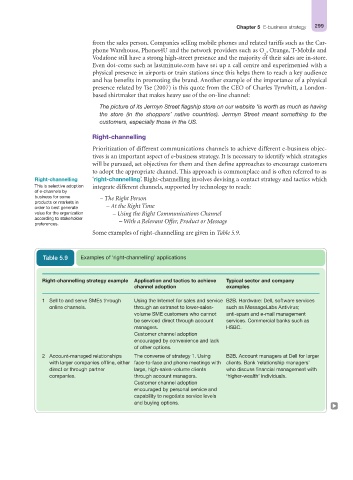
                                    Some examples of right-channelling are given in Table 5.9.


                    Table 5.9   Examples of ‘right-channelling’ applications


                    Right-channelling strategy example  Application and tactics to achieve  Typical sector and company
                                                 channel adoption             examples
                    1 Sell to and serve SMEs through  Using the Internet for sales and service B2B. Hardware: Dell, software services
                      online channels.           through an extranet to lower-sales-  such as MessageLabs Antivirus;

                                                 volume SME customers who cannot  anti-spam and e-mail management
                                                 be serviced direct through account  services. Commercial banks such as
                                                 managers.                    HSBC.
                                                 Customer channel adoption
                                                 encouraged by convenience and lack
                                                 of other options.
                    2 Account-managed relationships  The converse of strategy 1. Using  B2B. Account managers at Dell for larger
                      with larger companies offline, either face-to-face and phone meetings with  clients. Bank ‘relationship managers’
                      direct or through partner  large, high-sales-volume clients  who discuss financial management with
                      companies.                 through account managers.    ‘higher-wealth’ individuals.
                                                 Customer channel adoption
                                                 encouraged by personal service and
                                                 capability to negotiate service levels
                                                 and buying options.

