


Page 328 - E-Bussiness and E-Commerce Management Strategy, Implementation, and Practice
P. 328
M05_CHAF9601_04_SE_C05.QXD:D01_CHAF7409_04_SE_C01.QXD  16/4/09  11:12  Page 295


                                                                                 Chapter 5 E-business strategy  295


                                    3 Financial measures. Traditional measures such as turnover, costs, profitability and return on
                                      capital employed. For publicly quoted companies this measure is key to shareholder value.
                                      Example measures from Halifax Bank: gross receipts (£), mortgage offers (£), loans (£).
                                    4 Learning and growth: innovation and staff development. Innovation can be measured by
                                      change in value through time (employee value, shareholder value, percentage and value of
                                      sales from new products). Examples: management performance, training performance,
                                      new product development.

                                    For each of these four areas management teams will define objectives, specific measures, tar-
                                    gets and initiatives to achieve these targets. For some companies, such as Skandia Life, the
                                    balanced scorecard becomes much more than a performance measurement system and pro-
                                    vides a framework for the entire business strategy process. Olve et al. (1999) make the point
                                    that a further benefit of the scorecard is that it does not solely focus on outcomes, but also
                                    considers measures that are performance drivers that should positively affect the outcomes.
                                    For example, investment in technology and in employee training are performance drivers.
                                      More recently, as the scorecard has been widely used, it has been suggested that it provides
                                    a useful tool for aligning business and IS strategy, see for example der Zee and de Jong (1999).
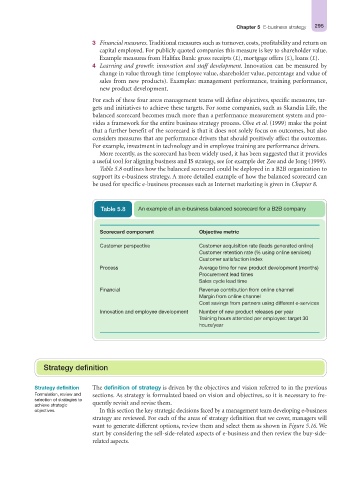
                                      Table 5.8 outlines how the balanced scorecard could be deployed in a B2B organization to
                                    support its e-business strategy. A more detailed example of how the balanced scorecard can
                                    be used for specific e-business processes such as Internet marketing is given in Chapter 8.


                                       Table 5.8  An example of an e-business balanced scorecard for a B2B company


                                      Scorecard component            Objective metric

                                      Customer perspective           Customer acquisition rate (leads generated online)
                                                                     Customer retention rate (% using online services)
                                                                     Customer satisfaction index
                                      Process                        Average time for new product development (months)
                                                                     Procurement lead times
                                                                     Sales cycle lead time
                                      Financial                      Revenue contribution from online channel
                                                                     Margin from online channel
                                                                     Cost savings from partners using different e-services
                                                                     Training hours attended per employee: target 30
                                      Innovation and employee development  Number of new product releases per year
                                                                     hours/year


                     Strategy definition


                  Strategy definition  The definition of strategy is driven by the objectives and vision referred to in the previous
                  Formulation, review and  sections. As strategy is formulated based on vision and objectives, so it is necessary to fre-
                  selection of strategies to
                  achieve strategic  quently revisit and revise them.
                  objectives.         In this section the key strategic decisions faced by a management team developing e-business
                                    strategy are reviewed. For each of the areas of strategy definition that we cover, managers will
                                    want to generate different options, review them and select them as shown in Figure 5.16. We
                                    start by considering the sell-side-related aspects of e-business and then review the buy-side-
                                    related aspects.

