


Page 333 - E-Bussiness and E-Commerce Management Strategy, Implementation, and Practice
P. 333
M05_CHAF9601_04_SE_C05.QXD:D01_CHAF7409_04_SE_C01.QXD  16/4/09  11:12  Page 300


                300  Part 2 Strategy and applications


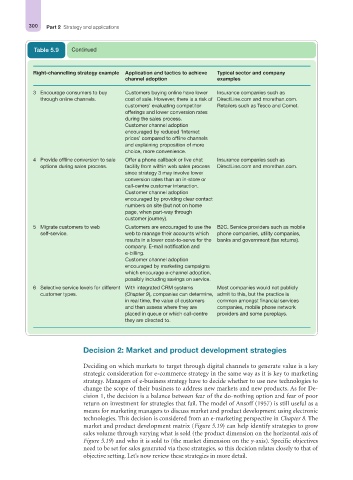
                  Table 5.9  Continued


                 Right-channelling strategy example  Application and tactics to achieve  Typical sector and company
                                              channel adoption             examples

                 3 Encourage consumers to buy  Customers buying online have lower  Insurance companies such as
                    through online channels.  cost of sale. However, there is a risk of DirectLine.com and morethan.com.
                                              customers’ evaluating competitor  Retailers such as Tesco and Comet.
                                              offerings and lower conversion rates
                                              during the sales process.
                                              Customer channel adoption
                                              encouraged by reduced ‘Internet
                                              prices’ compared to offline channels
                                              and explaining proposition of more
                                              choice, more convenience.
                 4 Provide offline conversion to sale  Offer a phone callback or live chat  Insurance companies such as
                    options during sales process.  facility from within web sales process  DirectLine.com and morethan.com.
                                              since strategy 3 may involve lower
                                              conversion rates than an in-store or
                                              call-centre customer interaction.
                                              Customer channel adoption
                                              encouraged by providing clear contact
                                              numbers on site (but not on home
                                              page, when part-way through
                                              customer journey).
                 5 Migrate customers to web   Customers are encouraged to use the  B2C. Service providers such as mobile
                    self-service.             web to manage their accounts which  phone companies, utility companies,
                                              results in a lower cost-to-serve for the  banks and government (tax returns).
                                              company. E-mail notification and
                                              e-billing.
                                              Customer channel adoption
                                              encouraged by marketing campaigns
                                              which encourage e-channel adoption,
                                              possibly including savings on service.
                 6 Selective service levels for different With integrated CRM systems  Most companies would not publicly
                    customer types.           (Chapter 9), companies can determine, admit to this, but the practice is
                                              in real time, the value of customers  common amongst financial services
                                              and then assess where they are  companies, mobile phone network

                                              placed in queue or which call-centre  providers and some pureplays.
                                              they are directed to.


                                 Decision 2: Market and product development strategies

                                 Deciding on which markets to target through digital channels to generate value is a key
                                 strategic consideration for e-commerce strategy in the same way as it is key to marketing
                                 strategy. Managers of e-business strategy have to decide whether to use new technologies to
                                 change the scope of their business to address new markets and new products. As for De-
                                 cision 1, the decision is a balance between fear of the do-nothing option and fear of poor
                                 return on investment for strategies that fail. The model of Ansoff (1957) is still useful as a
                                 means for marketing managers to discuss market and product development using electronic
                                 technologies. This decision is considered from an e-marketing perspective in Chapter 8. The
                                 market and product development matrix (Figure 5.19) can help identify strategies to grow
                                 sales volume through varying what is sold (the product dimension on the horizontal axis of
                                 Figure 5.19) and who it is sold to (the market dimension on the y-axis). Specific objectives
                                 need to be set for sales generated via these strategies, so this decision relates closely to that of
                                 objective setting. Let’s now review these strategies in more detail.

