


Page 337 - E-Bussiness and E-Commerce Management Strategy, Implementation, and Practice
P. 337
M05_CHAF9601_04_SE_C05.QXD:D01_CHAF7409_04_SE_C01.QXD  16/4/09  11:12  Page 304


                304  Part 2 Strategy and applications


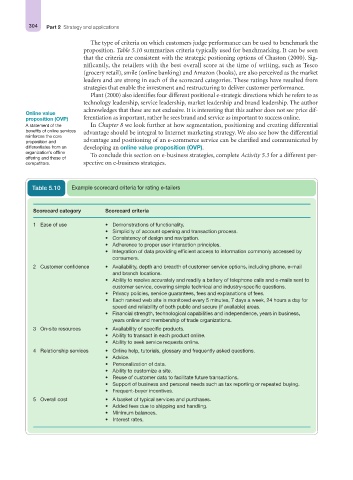
                                   The type of criteria on which customers judge performance can be used to benchmark the
                                 proposition. Table 5.10 summarizes criteria typically used for benchmarking. It can be seen
                                 that the criteria are consistent with the strategic postioning options of Chaston (2000). Sig-
                                 nificantly, the retailers with the best overall score at the time of writing, such as Tesco
                                 (grocery retail), smile (online banking) and Amazon (books), are also perceived as the market
                                 leaders and are strong in each of the scorecard categories. These ratings have resulted from
                                 strategies that enable the investment and restructuring to deliver customer performance.
                                   Plant (2000) also identifies four different positional e-strategic directions which he refers to as
                                 technology leadership, service leadership, market leadership and brand leadership. The author
                                 acknowledges that these are not exclusive. It is interesting that this author does not see price dif-
               Online value
               proposition (OVP)  ferentiation as important, rather he sees brand and service as important to success online.
               A statement of the  In Chapter 8 we look further at how segmentation, positioning and creating differential
               benefits of online services  advantage should be integral to Internet marketing strategy. We also see how the differential
               reinforces the core
               proposition and   advantage and positioning of an e-commerce service can be clarified and communicated by
               differentiates from an  developing an online value proposition (OVP).
               organization’s offline
               offering and those of  To conclude this section on e-business strategies, complete Activity 5.3 for a different per-
               competitors.      spective on e-business strategies.


                 Table 5.10  Example scorecard criteria for rating e-tailers


                 Scorecard category     Scorecard criteria
                 1 Ease of use          • Demonstrations of functionality.
                                        • Simplicity of account opening and transaction process.
                                        • Consistency of design and navigation.
                                        • Adherence to proper user interaction principles.
                                        • Integration of data providing efficient access to information commonly accessed by
                                          consumers.
                 2 Customer confidence  • Availability, depth and breadth of customer service options, including phone, e-mail
                                          and branch locations.
                                        • Ability to resolve accurately and readily a battery of telephone calls and e-mails sent to
                                          customer service, covering simple technical and industry-specific questions.
                                        • Privacy policies, service guarantees, fees and explanations of fees.
                                        • Each ranked web site is monitored every 5 minutes, 7 days a week, 24 hours a day for
                                          speed and reliability of both public and secure (if available) areas.

                                        • Financial strength, technological capabilities and independence, years in business,
                                          years online and membership of trade organizations.
                 3 On-site resources    • Availability of specific products.
                                        • Ability to transact in each product online.
                                        • Ability to seek service requests online.
                 4 Relationship services  • Online help, tutorials, glossary and frequently asked questions.
                                        • Advice.
                                        • Personalization of data.
                                        • Ability to customize a site.
                                        • Reuse of customer data to facilitate future transactions.
                                        • Support of business and personal needs such as tax reporting or repeated buying.
                                        • Frequent-buyer incentives.
                 5 Overall cost         • A basket of typical services and purchases.
                                        • Added fees due to shipping and handling.
                                        • Minimum balances.
                                        • Interest rates.

