


Page 330 - E-Bussiness and E-Commerce Management Strategy, Implementation, and Practice
P. 330
M05_CHAF9601_04_SE_C05.QXD:D01_CHAF7409_04_SE_C01.QXD  16/4/09  11:12  Page 297


                                                                                 Chapter 5 E-business strategy  297


                                    For ‘viability’ the metrics are:
                                      Market value potential (return on investment)
                                      Time to positive cash flow
                                      Personnel requirement
                                      Funding requirement.
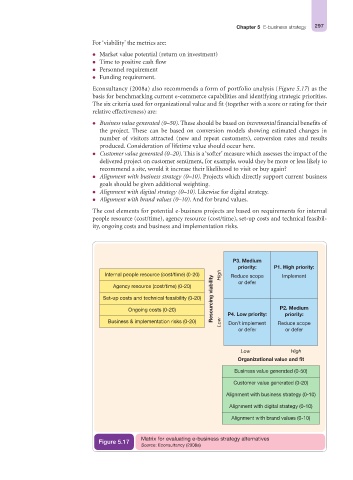
                                    Econsultancy (2008a) also recommends a form of portfolio analysis (Figure 5.17) as the
                                    basis for benchmarking current e-commerce capabilities and identifying strategic priorities.
                                    The six criteria used for organizational value and fit (together with a score or rating for their
                                    relative effectiveness) are:
                                      Business value generated (0–50). These should be based on incremental financial benefits of
                                      the project. These can be based on conversion models showing estimated changes in
                                      number of visitors attracted (new and repeat customers), conversion rates and results
                                      produced. Consideration of lifetime value should occur here.
                                      Customer value generated (0–20). This is a ‘softer’ measure which assesses the impact of the
                                      delivered project on customer sentiment, for example, would they be more or less likely to
                                      recommend a site, would it increase their likelihood to visit or buy again?
                                      Alignment with business strategy (0–10). Projects which directly support current business
                                      goals should be given additional weighting.
                                      Alignment with digital strategy (0–10). Likewise for digital strategy.
                                      Alignment with brand values (0–10). And for brand values.
                                    The cost elements for potential e-business projects are based on requirements for internal
                                    people resource (cost/time), agency resource (cost/time), set-up costs and technical feasibil-
                                    ity, ongoing costs and business and implementation risks.


                                                                                P3. Medium
                                                                                  priority:  P1. High priority:
                                        Internal people resource (cost/time) (0-20)  High  Reduce scope  Implement
                                                                          viability  or defer
                                          Agency resource (cost/time) (0-20)
                                       Set-up costs and technical feasibility (0-20)
                                               Ongoing costs (0-20)       Resourcing           P2. Medium
                                                                              P4. Low priority:  priority:
                                         Business & implementation risks (0-20)  Low  Don’t implement  Reduce scope
                                                                                  or defer       or defer


                                                                                   Low            High
                                                                                  Organizational value and fit
                                                                                 Business value generated (0-50)
                                                                                Customer value generated (0-20)

                                                                              Alignment with business strategy (0-10)
                                                                               Alignment with digital strategy (0-10)
                                                                                Alignment with brand values (0-10)


                                                   Matrix for evaluating e-business strategy alternatives
                                      Figure 5.17
                                                   Source: Econsultancy (2008a)

