


Page 331 - E-Bussiness and E-Commerce Management Strategy, Implementation, and Practice
P. 331
M05_CHAF9601_04_SE_C05.QXD:D01_CHAF7409_04_SE_C01.QXD  16/4/09  11:12  Page 298


                298  Part 2 Strategy and applications


                                 Decision 1: E-business channel priorities

                                 The e-business strategy must be directed according to the priority of different strategic
                                 objectives such as those in Table 5.6. If the priorities are for the sell-side downstream channel,
                                 as are objectives 1 to 3 in Table 5.6, then the strategy must be to direct resources at these
                                 objectives. For a B2B company that is well known in its marketplace worldwide and cannot
                                 offer products to new markets, an initial investment on buy-side channel upstream channel
                                 e-commerce and value chain management may be more appropriate.
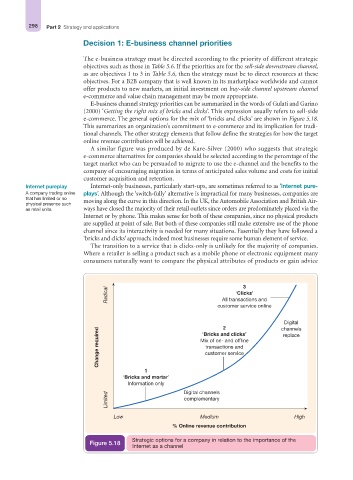
                                   E-business channel strategy priorities can be summarized in the words of Gulati and Garino
                                 (2000) ‘Getting the right mix of bricks and clicks’. This expression usually refers to sell-side
                                 e-commerce. The general options for the mix of ‘bricks and clicks’ are shown in Figure 5.18.
                                 This summarizes an organization’s commitment to e-commerce and its implication for tradi-
                                 tional channels. The other strategy elements that follow define the strategies for how the target
                                 online revenue contribution will be achieved.
                                   A similar figure was produced by de Kare-Silver (2000) who suggests that strategic
                                 e-commerce alternatives for companies should be selected according to the percentage of the
                                 target market who can be persuaded to migrate to use the e-channel and the benefits to the
                                 company of encouraging migration in terms of anticipated sales volume and costs for initial
                                 customer acquisition and retention.
               Internet pureplay   Internet-only businesses, particularly start-ups, are sometimes referred to as ‘Internet pure-
               A company trading online  plays’. Although the ‘switch-fully’ alternative is impractical for many businesses, companies are
               that has limited or no
               physical presence such  moving along the curve in this direction. In the UK, the Automobile Association and British Air-
               as retail units.  ways have closed the majority of their retail outlets since orders are predominately placed via the
                                 Internet or by phone. This makes sense for both of these companies, since no physical products
                                 are supplied at point of sale. But both of these companies still make extensive use of the phone
                                 channel since its interactivity is needed for many situations. Essentially they have followed a
                                 ‘bricks and clicks’ approach; indeed most businesses require some human element of service.
                                   The transition to a service that is clicks-only is unlikely for the majority of companies.
                                 Where a retailer is selling a product such as a mobile phone or electronic equipment many
                                 consumers naturally want to compare the physical attributes of products or gain advice


                                                                                   3
                                         Radical                             All transactions and
                                                                                 ʻClicksʼ
                                                                           customer service online


                                                                                                Digital
                                                                             2
                                                                                               channels
                                      required                        Mix of on- and offline    replace
                                                                      ʻBricks and clicksʼ
                                                                       transactions and
                                      Change                           customer service

                                                    1
                                             ʻBricks and mortarʼ
                                               Information only
                                         Limited                 Digital channels
                                                                 complementary

                                           Low                        Medium                       High
                                                             % Online revenue contribution

                                                Strategic options for a company in relation to the importance of the
                                   Figure 5.18
                                                Internet as a channel

