


Page 327 - E-Bussiness and E-Commerce Management Strategy, Implementation, and Practice
P. 327
M05_CHAF9601_04_SE_C05.QXD:D01_CHAF7409_04_SE_C01.QXD  16/4/09  11:12  Page 294


                294  Part 2 Strategy and applications


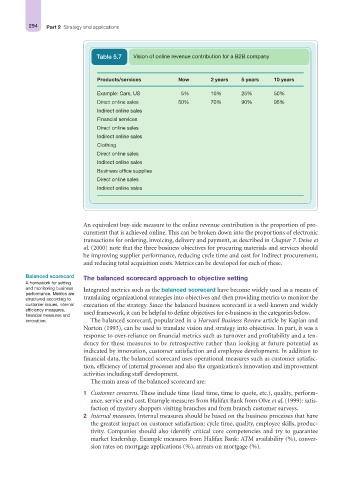
                                     Table 5.7   Vision of online revenue contribution for a B2B company


                                     Products/services         Now       2 years   5 years   10 years

                                     Example: Cars, US          5%       10%       25%       50%
                                     Direct online sales       50%       70%       90%       95%
                                     Indirect online sales
                                     Financial services
                                     Direct online sales
                                     Indirect online sales
                                     Clothing
                                     Direct online sales
                                     Indirect online sales
                                     Business office supplies
                                     Direct online sales
                                     Indirect online sales


                                 An equivalent buy-side measure to the online revenue contribution is the proportion of pro-
                                 curement that is achieved online. This can be broken down into the proportions of electronic
                                 transactions for ordering, invoicing, delivery and payment, as described in Chapter 7. Deise et
                                 al. (2000) note that the three business objectives for procuring materials and services should
                                 be improving supplier performance, reducing cycle time and cost for indirect procurement,
                                 and reducing total acquisition costs. Metrics can be developed for each of these.

               Balanced scorecard  The balanced scorecard approach to objective setting
               A framework for setting
               and monitoring business  Integrated metrics such as the balanced scorecard have become widely used as a means of
               performance. Metrics are
               structured according to  translating organizational strategies into objectives and then providing metrics to monitor the
               customer issues, internal  execution of the strategy. Since the balanced business scorecard is a well-known and widely
               efficiency measures,

               financial measures and  used framework, it can be helpful to define objectives for e-business in the categories below.
               innovation.         The balanced scorecard, popularized in a Harvard Business Review article by Kaplan and
                                 Norton (1993), can be used to translate vision and strategy into objectives. In part, it was a
                                 response to over-reliance on financial metrics such as turnover and profitability and a ten-
                                 dency for these measures to be retrospective rather than looking at future potential as
                                 indicated by innovation, customer satisfaction and employee development. In addition to
                                 financial data, the balanced scorecard uses operational measures such as customer satisfac-
                                 tion, efficiency of internal processes and also the organization’s innovation and improvement
                                 activities including staff development.
                                   The main areas of the balanced scorecard are:
                                 1 Customer concerns. These include time (lead time, time to quote, etc.), quality, perform-
                                   ance, service and cost. Example measures from Halifax Bank from Olve et al. (1999): satis-
                                   faction of mystery shoppers visiting branches and from branch customer surveys.
                                 2 Internal measures. Internal measures should be based on the business processes that have
                                   the greatest impact on customer satisfaction: cycle time, quality, employee skills, produc-
                                   tivity. Companies should also identify critical core competencies and try to guarantee
                                   market leadership. Example measures from Halifax Bank: ATM availability (%), conver-
                                   sion rates on mortgage applications (%), arrears on mortgage (%).

