


Page 367 - E-Bussiness and E-Commerce Management Strategy, Implementation, and Practice
P. 367
M06_CHAF9601_04_SE_C06.QXD:D01_CHAF7409_04_SE_C01.QXD  16/4/09  11:13  Page 334


                334  Part 2 Strategy and applications


                                   The benefits of supply chain management according to a PMP (2008) survey are shown
                                   in Figure 6.1. You can see that although benefits of reducing costs and increasing prof-
                                   itability are mentioned frequently, many respondents mentioned that supply chain
                                   management also assists with delivering better service to customers.
                                      The figure also shows the challenges of implementing supply chain management
                                   technology since a large proportion had not fully realised the intended benefits,
                                   although the majority believed they would in the long term.

                                   Sample frame
                                   PMP surveyed a broad range of companies, including those from the manufacturing
                                   (32%) and retail sectors (17%) where supply chain issues are particularly important. In
                                   addition companies responded from distribution & logistics (13%), energy & utilities
                                   (10%) and IT & telecoms (6%). The respondents represent a spread of different-sized
                                   companies, with 16% having in excess of £5 billion turnover, 7% in the £1 billion to £5
                                   billion bracket and 13% in the £500 million to £1 billion range.


                                 Much of the excitement generated by the e-business concept concerns the benefits that com-
                                 panies can achieve through increasing the efficiency of the whole supply chain. Companies
                                 such as Tesco (Case Study 6.2), that have enthusiastically embraced technology to manage
                                 the supply chain, have been reaping the benefits for many years.

                                 Problems of supply chain management

                                 We have reviewed some of the benefits of using technology to support supply chain manage-
                                 ment in Box 6.1. We can also review the benefits of SCM from the perspective of problems that
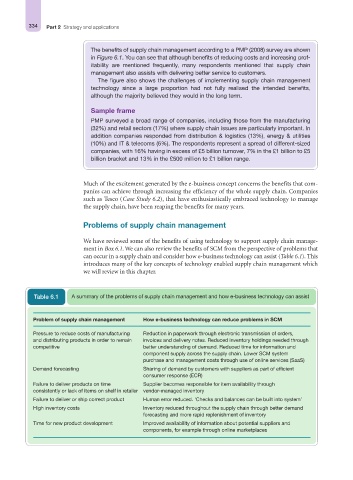
                                 can occur in a supply chain and consider how e-business technology can assist (Table 6.1). This
                                 introduces many of the key concepts of technology enabled supply chain management which
                                 we will review in this chapter.


                  Table 6.1  A summary of the problems of supply chain management and how e-business technology can assist

                 Problem of supply chain management  How e-business technology can reduce problems in SCM

                 Pressure to reduce costs of manufacturing  Reduction in paperwork through electronic transmission of orders,
                 and distributing products in order to remain  invoices and delivery notes. Reduced inventory holdings needed through
                 competitive                        better understanding of demand. Reduced time for information and
                                                    component supply across the supply chain. Lower SCM system
                                                    purchase and management costs through use of online services (SaaS)
                 Demand forecasting                 Sharing of demand by customers with suppliers as part of efficient
                                                    consumer response (ECR)
                 Failure to deliver products on time  Supplier becomes responsible for item availability through
                 consistently or lack of items on shelf in retailer  vendor-managed inventory
                 Failure to deliver or ship correct product  Human error reduced. ‘Checks and balances can be built into system’
                 High inventory costs               Inventory reduced throughout the supply chain through better demand
                                                    forecasting and more rapid replenishment of inventory
                 Time for new product development   Improved availability of information about potential suppliers and
                                                    components, for example through online marketplaces

