


Page 115 - Electric Machinery Fundamentals
P. 115
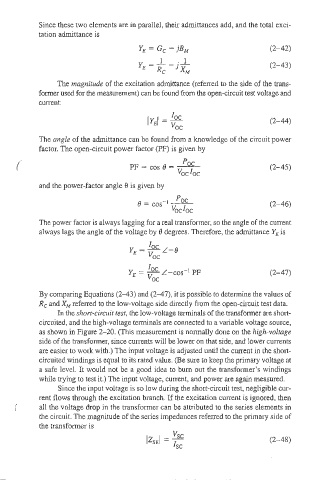
Since these two elements are in parallel, their admittances add, and the total exci-
           tation admittance is
                                     Y =  G - JBM                     (2-42)
                                           e
                                      E
                                     Y  _ ..L _ j_1                   (2-43)
                                      E  - Re   X
                                                 M
                The magnitude of the excitation admittance (referred to the side of the trans-
           fmmer used for the measurement) can be found from the open-circult test voltage and
           current:
                                             l  oe
                                       iYEi =  v                      (2-44)
                                              oe
           The angle of the admittance can be found from  a knowledge of the circuit power
           factor. The open-circuit power factor (PF) is given by
                                                Poe
     (                            PF  =  cos e =  --                  (2- 45)
                                               Voel oe
           and the power-factor angle e is given by
                                              Poe
                                    8 =  cos- 1 _--                   (2-46)
                                                /
                                             V oe oe
           The power factor is always lagging for a real transformer, so the angle of the current
           always lags the angle of the voltage by e degrees. Therefore, the admittance Y E  is


                                                                      (2-47)

           By comparing Equations (2-43) and (2-47), it is possible to determine the values of
           Rc and X referred to the low-voltage side directly from the open-circuit test data.
                  M
                In the short-circuit test, the low-voltage terminals of the transfonner are short-
           circuited, and the high-voltage tenninals are connected to a variable voltage source,
           as shown in Figure 2-20. (This measurement is nOImally done on the high-voltage
           side of the transformer,  since currents will be lower on that side, and lower CUiTents
           are easier to work with.) The input voltage is adjusted until the current in the short-
           circuited windings is equal to its rated value. (Be sure to keep the primary voltage at
           a safe  level.  It  would  not be  a good idea  to  burn  out  the  transformer's  windings
           while trying to test it.) The input voltage, CUlTent, and power are again measured.
                Since the input voltage is so low during the short-circuit test, negligible cur-
           rent flows through the excitation branch. If the excitation cunent is ignored, then
           all  the voltage drop in  the transfonner can  be attributed to the series elements in
           the circuit. The magnitude of the series impedances referred to the primary side of
           the transformer is
                                                                      (2-48)

