


Page 118 - Electric Machinery Fundamentals
P. 118
94   ELECTRIC MACHINERY FUNDAMENTALS

                                                     I,
                Ip                  Roq     jX cq   ~
                                   AAA                  ,
               +                     V     ~             +
                I          j        {8 /n   jl92n
                  IJr+e J       pm

                                 jX
             Vp       ~  ~ R,      m                      aV,
                      <          j38.4 kn
                        159 kn

                \~--_~I----------~


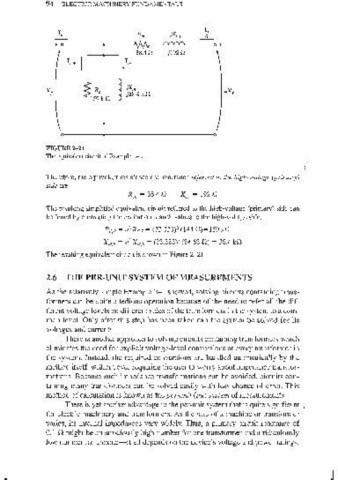
             FIGURE 2-21
             The equivalent circuit of Example 2-2.
                                                                               (
             Therefore, the equivalent resistance and reactance referred to  the high-voltage (primary)
             side are
                                               Xeq  = 1920

             The resulting simplified equivalent circuit refelTed to the high-voltage (primary) side can
             be found by converting the excitation branch values to the high-voltage side.
                                  2
                            Re,p  ~ a Res ~ (33.333)' (1 44 D)~ 1 59 kD
                           X"J' ~ a' X M • S  ~ (33.333)' (34.63 D)  ~ 38.4 kD
             The resulting equivalent circuit is shown in Figure 2- 21.


             2.6  THE PER-UNIT SYSTEM OF MEASUREMENTS
             As the relatively simple Example 2-1 showed, solving circuits containing trans-
             formers can be quite a tedious operation because of the need to refer all the dif-
             ferent voltage levels on different sides of the transformers in the system to a com-
             mon level.  Only after this step has  been taken can the  system be solved for its
             voltages and currents.
                  There is another approach to solving circuits containing transformers which
             eliminates the need for explicit voltage-level conversions at every transformer in
             the system. Instead,  the  required conversions are handled automatically by  the
             method itself, without ever requiring the user to worry about impedance transfor-
             mations. Because such impedance transformations can be avoided, circuits con-
             taining many transformers can be solved easily with less chance of error. This
             method of calculation is known as  the per-unit (pu) system of measurements.
                  There is yet another advantage to the per-unit system that is quite significant
             for  electric machinery and transformers. As  the  size of a machine or transformer
             varies, its internal impedances vary  widely.  Thus,  a primary circuit reactance of
             0.1 n might be an atrociously high number for one transformer and a ridiculously
             low number for another-it all depends on the device's voltage and power ratings.

