


Page 116 - Electric Machinery Fundamentals
P. 116
Y2   EL ECTRIC MACHINERY  FUNDAM EN'fALS

                                     tt
                                 ,_W=a"m=et~er~,  ip (/)
                                                +   •   •


                                                 Transformer

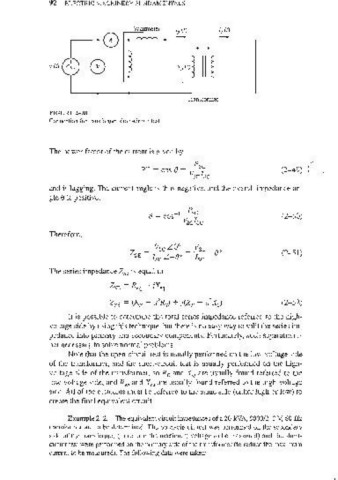
              FIGURE 2-20
              Connection for transformer shOtt-circuit test.


              The power factor of the current is given by
                                                  Fsc
                                     PF  ~ cos e ~--                     (2-49)  (
                                                 Vsc1sc
              and is lagging. The current angle is thus negative, and the overall impedance an-
              gle e is positive:

                                                                         (2-50)

              Therefore,
                                              c
                                        Vsc LO
                                  ZSE  ~ I   / _ ""                      (2- 51)
                                         sc L..   (J
              The series impedance ZSE is equal to
                             2SE  ~ Req  + iX,q

                                                                         (2-52)
                  It is possible to determine the total series impedance referred to the high-
              voltage side by using this technique, but there is no easy way to split the series im-
             pedance into primary and secondary components. Fortunately, such separation is
              not necessary to solve normal problems.
                  Note that the open-circuit test is usually performed on the low-voltage side
              of the transformer,  and  the  short-circuit test is  usually performed on  the  high-
              voltage side of the transformer, so Rc and X are usually found  referred to the
                                                  M
              low-voltage side, and R eq  and X eq are usually found referred to the high-voltage
              side. All of the elements must be referred to the same side (either high or low) to
              create the final equivalent circuit.

                  Example 2-2.  The equivalent circuit impedances of a 20-kVA, 8000/240 V, 60-Hz
              transformer are to  be determined. The open-circuit test was performed on  the secondary
              side of the transformer (to reduce the maximum voltage to be  measured) and  the  short-
             circuit test were performed on the primary side of tbe transformer (to reduce the maximum
             current to be measured). The following data were taken:

