


Page 175 - Electrical Equipment Handbook _ Troubleshooting and Maintenance
P. 175
POWER ELECTRONICS, RECTIFIERS, AND PULSE-WIDTH MODULATION INVERTERS

            9.2                        CHAPTER NINE

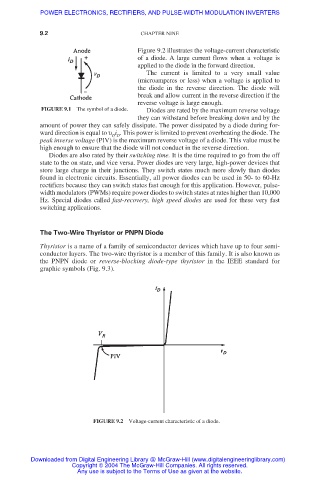
                                      Figure 9.2 illustrates the voltage-current characteristic
                                      of a diode. A large current  flows when a voltage is
                                      applied to the diode in the forward direction.
                                         The current is limited to a very small value
                                      (microamperes or less) when a voltage is applied to
                                      the diode in the reverse direction. The diode will
                                      break and allow current in the reverse direction if the
                                      reverse voltage is large enough.
            FIGURE 9.1 The symbol of a diode.  Diodes are rated by the maximum reverse voltage
                                      they can withstand before breaking down and by the
            amount of power they can safely dissipate. The power dissipated by a diode during for-
            ward direction is equal to υ i . This power is limited to prevent overheating the diode. The
                               D D
            peak inverse voltage (PIV) is the maximum reverse voltage of a diode. This value must be
            high enough to ensure that the diode will not conduct in the reverse direction.
              Diodes are also rated by their switching time. It is the time required to go from the off
            state to the on state, and vice versa. Power diodes are very large, high-power devices that
            store large charge in their junctions. They switch states much more slowly than diodes
            found in electronic circuits. Essentially, all power diodes can be used in 50- to 60-Hz
            rectifiers because they can switch states fast enough for this application. However, pulse-
            width modulators (PWMs) require power diodes to switch states at rates higher than 10,000
            Hz. Special diodes called fast-recovery, high speed diodes are used for these very fast
            switching applications.


            The Two-Wire Thyristor or PNPN Diode
            Thyristor is a name of a family of semiconductor devices which have up to four semi-
            conductor layers. The two-wire thyristor is a member of this family. It is also known as
            the PNPN diode or  reverse-blocking diode-type thyristor in the IEEE standard for
            graphic symbols (Fig. 9.3).


                          FIGURE 9.2 Voltage-current characteristic of a diode.


         Downloaded from Digital Engineering Library @ McGraw-Hill (www.digitalengineeringlibrary.com)
                    Copyright © 2004 The McGraw-Hill Companies. All rights reserved.
                      Any use is subject to the Terms of Use as given at the website.

