


Page 176 - Electrical Equipment Handbook _ Troubleshooting and Maintenance
P. 176
POWER ELECTRONICS, RECTIFIERS, AND PULSE-WIDTH MODULATION INVERTERS

                           POWER ELECTRONICS, RECTIFIERS, AND INVERTERS    9.3

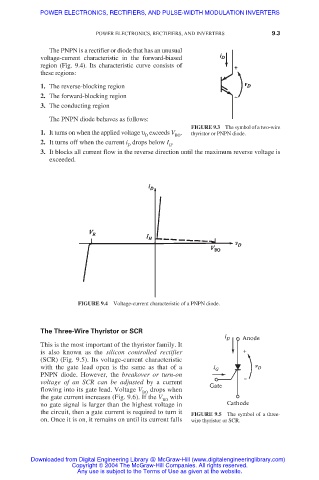
              The PNPN is a rectifier or diode that has an unusual
            voltage-current characteristic in the forward-biased
            region (Fig. 9.4). Its characteristic curve consists of
            these regions:
            1. The reverse-blocking region
            2. The forward-blocking region
            3. The conducting region

              The PNPN diode behaves as follows:
                                                     FIGURE 9.3 The symbol of a two-wire
            1. It turns on when the applied voltage υ exceeds V .  thyristor or PNPN diode.
                                        D
                                                BO
            2. It turns off when the current i drops below I .
                                    D          H
            3. It blocks all current flow in the reverse direction until the maximum reverse voltage is
              exceeded.


                      FIGURE 9.4 Voltage-current characteristic of a PNPN diode.


            The Three-Wire Thyristor or SCR
            This is the most important of the thyristor family. It
            is also known as the  silicon controlled rectifier
            (SCR) (Fig. 9.5). Its voltage-current characteristic
            with the gate lead open is the same as that of a
            PNPN diode. However, the  breakover or turn-on
            voltage of an SCR can be adjusted by a current
            flowing into its gate lead. Voltage V BO  drops when
            the gate current increases (Fig. 9.6). If the V  with
                                             BO
            no gate signal is larger than the highest voltage in
            the circuit, then a gate current is required to turn it  FIGURE 9.5 The symbol of a three-
            on. Once it is on, it remains on until its current falls  wire thyristor or SCR.


         Downloaded from Digital Engineering Library @ McGraw-Hill (www.digitalengineeringlibrary.com)
                    Copyright © 2004 The McGraw-Hill Companies. All rights reserved.
                      Any use is subject to the Terms of Use as given at the website.

