


Page 250 - Electrical Installation in Hazardous Area
P. 250
21 4  Electrical installations in hazardous areas


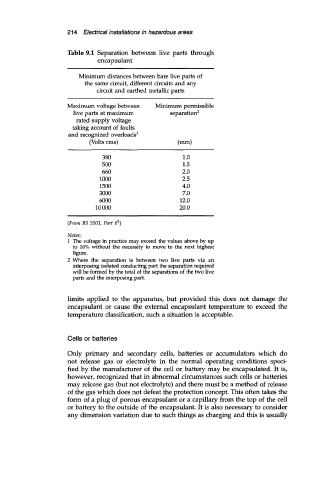
                     Table 9.1 Separation between live parts  through
                               encapsulant

                         Minimum distances between bare live parts of
                           the same circuit, different circuits and any
                              circuit and earthed metallic parts

                     Maximum voltage between    Minimum permissible
                       live parts at maximum        separation*
                        rated supply voltage
                       taking account of  faults
                      and recognized overloads'
                            (Volts rms)                (-1
                                                       ~
                                380                     1 .o
                                500                     1.5
                                660                     2.0
                               1000                     2.5
                               1500                     4.0
                               3000                     7.0
                               6000                    12.0
                              10 000                   20.0

                      (From BS  5501, Part S3)

                     Notes:
                      1 The voltage in practice may exceed the values above by up
                       to  10% without the  necessity to move to the next highest
                       figure.
                     2  Where  the  separation  is  between  two  live  parts  via  an
                       interposing isolated conducting part the separation required
                       will be formed by the total of  the separations of the two live
                       parts and the interposing part.


                     limits applied  to  the apparatus, but  provided  this does not  damage the
                      encapsulant or cause the external encapsulant temperature to exceed the
                     temperature classification, such a situation is acceptable.


                      Cells or batteries

                     Only  primary  and  secondary cells,  batteries or  accumulators which  do
                     not  release  gas  or  electrolyte in  the  normal  operating conditions speci-
                      fied by the manufacturer of  the cell or battery may be encapsulated. It is,
                     however, recognized that in abnormal circumstances such cells or batteries
                     may release gas (but not electrolyte) and there must be a method of  release
                      of  the gas which does not defeat the protection concept. This often takes the
                     form of  a plug of  porous encapsulant or a capillary from the top of  the cell
                     or battery to the outside of  the encapsulant. It is also necessary to consider
                     any dimension variation due to such things as charging and this is usually

