


Page 423 - Electrical Properties of Materials
P. 423
Natural and artificial materials                    405

                       a                 b  c                 d
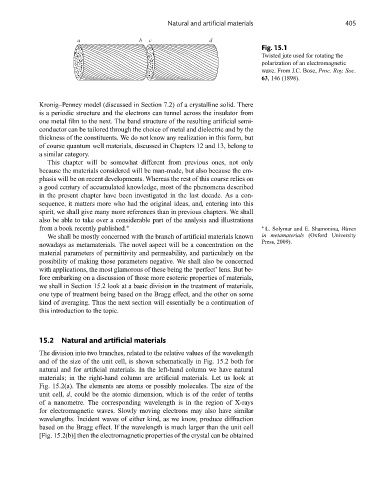
                                                                             Fig. 15.1
                                                                             Twisted jute used for rotating the
                                                                             polarization of an electromagnetic
                                                                             wave. From J.C. Bose, Proc. Roy. Soc.
                                                                             63, 146 (1898).


            Kronig–Penney model (discussed in Section 7.2) of a crystalline solid. There
            is a periodic structure and the electrons can tunnel across the insulator from
            one metal film to the next. The band structure of the resulting artificial semi-
            conductor can be tailored through the choice of metal and dielectric and by the
            thickness of the constituents. We do not know any realization in this form, but
            of course quantum well materials, discussed in Chapters 12 and 13, belong to
            a similar category.
               This chapter will be somewhat different from previous ones, not only
            because the materials considered will be man-made, but also because the em-
            phasis will be on recent developments. Whereas the rest of this course relies on
            a good century of accumulated knowledge, most of the phenomena described
            in the present chapter have been investigated in the last decade. As a con-
            sequence, it matters more who had the original ideas, and, entering into this
            spirit, we shall give many more references than in previous chapters. We shall
            also be able to take over a considerable part of the analysis and illustrations
            from a book recently published. ∗                                ∗  L. Solymar and E. Shamonina, Waves
               We shall be mostly concerned with the branch of artificial materials known  in metamaterials (Oxford University
                                                                             Press, 2009).
            nowadays as metamaterials. The novel aspect will be a concentration on the
            material parameters of permittivity and permeability, and particularly on the
            possibility of making those parameters negative. We shall also be concerned
            with applications, the most glamorous of these being the ‘perfect’ lens. But be-
            fore embarking on a discussion of those more esoteric properties of materials,
            we shall in Section 15.2 look at a basic division in the treatment of materials,
            one type of treatment being based on the Bragg effect, and the other on some
            kind of averaging. Thus the next section will essentially be a continuation of
            this introduction to the topic.


            15.2 Natural and artificial materials

            The division into two branches, related to the relative values of the wavelength
            and of the size of the unit cell, is shown schematically in Fig. 15.2 both for
            natural and for artificial materials. In the left-hand column we have natural
            materials; in the right-hand column are artificial materials. Let us look at
            Fig. 15.2(a). The elements are atoms or possibly molecules. The size of the
            unit cell, d, could be the atomic dimension, which is of the order of tenths
            of a nanometre. The corresponding wavelength is in the region of X-rays
            for electromagnetic waves. Slowly moving electrons may also have similar
            wavelengths. Incident waves of either kind, as we know, produce diffraction
            based on the Bragg effect. If the wavelength is much larger than the unit cell
            [Fig. 15.2(b)] then the electromagnetic properties of the crystal can be obtained

