


Page 425 - Electrical Properties of Materials
P. 425
Photonic bandgap materials                        407

            permittivity and negative permeability at the same frequency, which will then
            lead to both negative refractive index and negative refraction.


            15.3 Photonic bandgap materials
            As we know, electrons in a semiconductor have allowed and forbidden ener-
            gies. We have seen and discussed that umpteen times. Why do electrons behave
            that way? We have discussed that too. It is essentially due to the wave-like
            nature of the electron. When they see a periodic potential in a periodic medium,
            they respond. But why only electrons? Could not photons do the same thing if
            they find themselves in a periodic medium? Yes, of course, we discussed that
            too in relation to the Bragg effect. So the idea is obvious. Put photons into a
            periodic medium and they will have allowed and forbidden energies which, in
            this context, means that the propagation of the electromagnetic waves in that
            medium is allowed or forbidden. The modern term for it is photonic bandgaps.
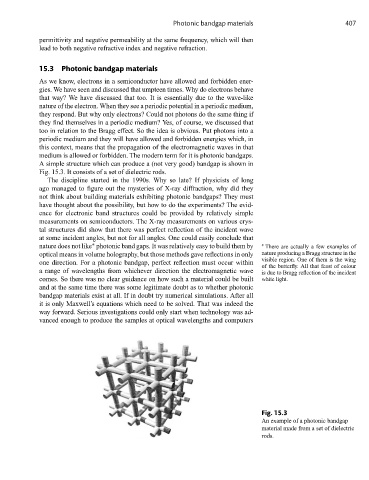
            A simple structure which can produce a (not very good) bandgap is shown in
            Fig. 15.3. It consists of a set of dielectric rods.
               The discipline started in the 1990s. Why so late? If physicists of long
            ago managed to figure out the mysteries of X-ray diffraction, why did they
            not think about building materials exhibiting photonic bandgaps? They must
            have thought about the possibility, but how to do the experiments? The evid-
            ence for electronic band structures could be provided by relatively simple
            measurements on semiconductors. The X-ray measurements on various crys-
            tal structures did show that there was perfect reflection of the incident wave
            at some incident angles, but not for all angles. One could easily conclude that
                            ∗
            nature does not like photonic band gaps. It was relatively easy to build them by  ∗  There are actually a few examples of
            optical means in volume holography, but those methods gave reflections in only  nature producing a Bragg structure in the
                                                                             visible region. One of them is the wing
            one direction. For a photonic bandgap, perfect reflection must occur within
                                                                             of the butterfly. All that feast of colour
            a range of wavelengths from whichever direction the electromagnetic wave  is due to Bragg reflection of the incident
            comes. So there was no clear guidance on how such a material could be built  white light.
            and at the same time there was some legitimate doubt as to whether photonic
            bandgap materials exist at all. If in doubt try numerical simulations. After all
            it is only Maxwell’s equations which need to be solved. That was indeed the
            way forward. Serious investigations could only start when technology was ad-
            vanced enough to produce the samples at optical wavelengths and computers


                                                                             Fig. 15.3
                                                                             An example of a photonic bandgap
                                                                             material made from a set of dielectric
                                                                             rods.

